Credit card interest can look like a single charge that appears once a month. Underneath that line item is a daily calculation.
The card issuer starts with an annual percentage rate, or APR. It converts that annual rate into a periodic rate. It then applies that periodic rate to a balance defined by the card agreement. Purchases, cash advances and balance transfers may have different APRs and different rules.
That is why two cards with the same headline APR can produce different interest charges. The balance, transaction dates, payment dates, billing-cycle length, grace period and calculation method all matter.
Financial disclaimer: This article is general educational commentary, not financial, investment, tax or legal advice. Card agreements, fees, APRs and interest methods vary. Read your current agreement and statement for the terms that apply to your account.
Quick answer: How is credit card interest calculated?
A common method is to divide the card's APR by 365 to get a daily periodic rate. The issuer calculates the balance for each day of the billing cycle, often using the average daily balance method. It then applies the daily rate for the number of days in the cycle.
For illustration, a 22.36% APR divided by 365 is about 0.06126% per day. If the applicable balance stayed at exactly $5,000 for 30 days, a simple estimate would be about $91.89 in interest. Real statement interest can differ because balances change, some issuers use a different divisor, transactions may have separate APRs, and the card's agreement controls the calculation.
Key facts
- APR is an annualized rate. It is not the amount charged once per year.
- Many issuers convert APR into a daily periodic rate and apply it during each billing cycle.
- The average daily balance method gives each day's balance a place in the calculation.
- A purchase made early in a cycle can affect more daily balances than the same purchase made near the end.
- A payment can reduce future daily balances when it is credited, subject to the issuer's posting rules.
- A grace period can allow qualifying purchases to avoid interest when the required balance is paid in full by the due date.
- Cash advances often begin accruing interest on the transaction date and may use a separate APR.
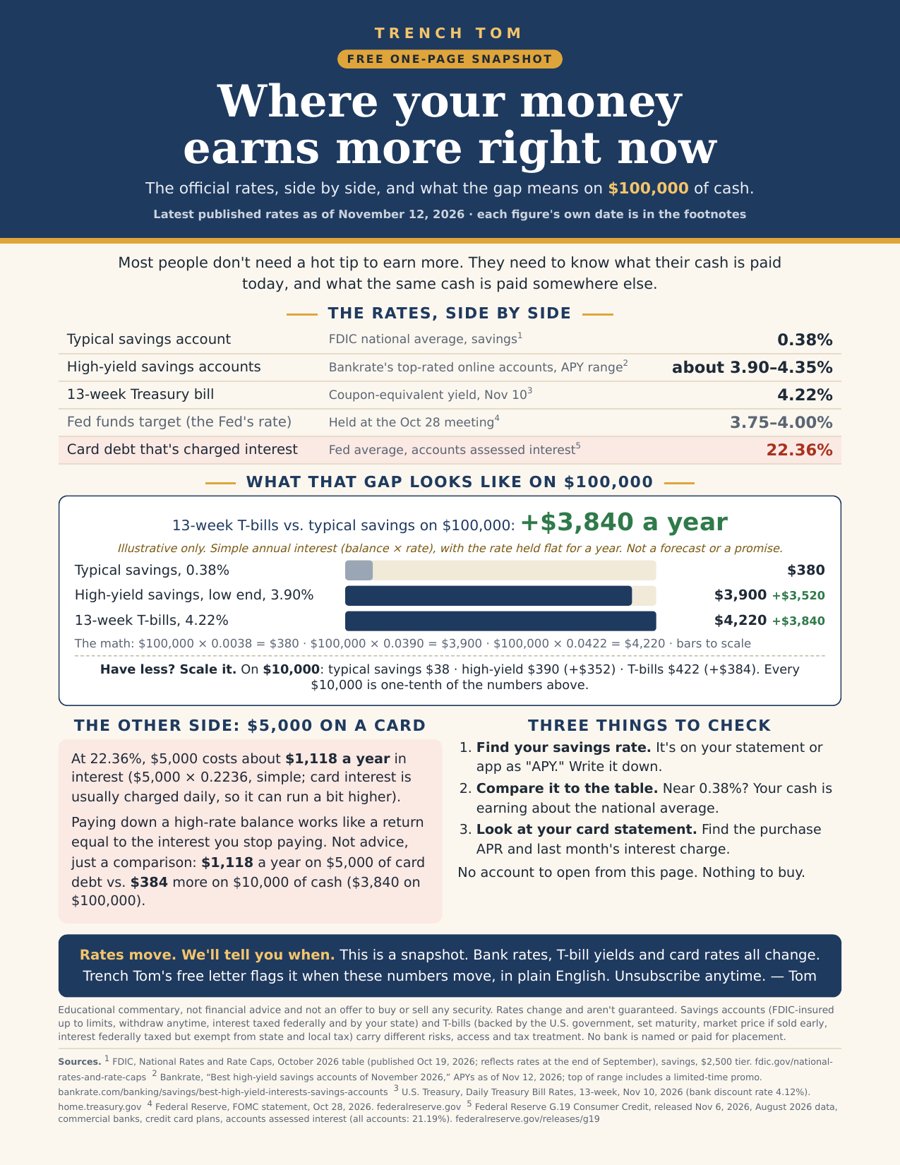
- The Federal Reserve's November 6, 2026 G.19 release reported a 22.36% average APR in August 2026 for credit card accounts that were assessed interest.
- A statement's minimum-payment warning is not a prediction. It shows required disclosures based on stated assumptions.
What does a credit card APR actually mean?
APR stands for annual percentage rate. On a credit card, it expresses the interest rate on an annual basis so rates can be disclosed in a common format.
The card normally does not wait until the end of a year to calculate interest. The issuer converts the APR into a periodic rate. A daily periodic rate is common.
A card can have more than one APR:
- a purchase APR;
- a cash-advance APR;
- a balance-transfer APR;
- an introductory APR that lasts for a stated period;
- a penalty APR that may apply after specified events.
Those rates should not be blended into one mental number. A $1,000 purchase balance and a $1,000 cash-advance balance may accrue interest differently even when both sit on the same account.
The APR also does not include every possible card cost. Annual fees, late fees, cash-advance fees, foreign-transaction fees and balance-transfer fees are separate terms. A card with a lower APR can still cost more in a particular situation if other fees apply. A card with no annual fee can still be expensive when a balance is carried.
The useful starting point is the statement's interest-charge calculation section. Federal rules require periodic statements to disclose each balance category on which a finance charge was imposed, the APRs that applied, and other information about how the finance charge was determined.
How do you turn APR into a daily interest rate?
A common conversion uses this formula:
Daily periodic rate = APR ÷ 365
Using the latest Federal Reserve figure for accounts assessed interest as an example:
22.36% ÷ 365 = about 0.06126% per day
The decimal form used in a calculation is about 0.0006126 per day.
Here is a simple illustration. It assumes one constant balance, one APR, a 365-day divisor, no new transactions, no fees, no compounding within the period and a 30-day billing cycle.
| Illustration | Formula | Amount |
|---|---|---|
| Starting balance | Assumed constant balance | $5,000.00 |
| APR | Federal Reserve August 2026 average for accounts assessed interest | 22.36% |
| Daily periodic rate | 22.36% ÷ 365 | About 0.06126% |
| Daily interest estimate | $5,000 × 0.2236 ÷ 365 | About $3.06 |
| 30-day interest estimate | $5,000 × 0.2236 ÷ 365 × 30 | About $91.89 |
This is an illustration, not a statement estimate and not a promise about any card. An issuer may use 360 days or another method allowed by the agreement and applicable law. The balance can change every day. Interest may compound. Different balance categories can use different rates.
The example also shows why small-looking daily rates matter. A daily percentage below one-tenth of one percent can still create a noticeable monthly charge when it is applied to thousands of dollars across many days.
How does the average daily balance method work?
The average daily balance method tracks the applicable balance on each day in the billing cycle.
In simplified form, the issuer:
- starts with the balance for day one;
- adds purchases, advances, fees or other debits when the agreement says they enter the balance;
- subtracts payments and credits when they are posted;
- records the ending balance for each day;
- adds all daily balances together;
- divides that total by the number of days in the billing cycle;
- applies the periodic rate under the card's formula.
Consider a 30-day cycle with a $2,000 balance for the first 10 days and a $1,000 balance for the next 20 days after a payment is credited.
The average daily balance would be:
(($2,000 × 10) + ($1,000 × 20)) ÷ 30 = $1,333.33
At a 22.36% APR with a 365-day divisor, a simplified interest estimate would be:
$1,333.33 × 0.2236 ÷ 365 × 30 = about $24.50
Now move the same $1,000 payment later. If the balance stayed at $2,000 for 20 days and $1,000 for only 10 days, the average daily balance would be $1,666.67. The simplified interest estimate would rise to about $30.63.
The payment amount did not change. The posting date changed how many daily balances received the benefit. That is the core mechanic.
Your issuer's exact method may include previous-cycle activity, separate balance buckets, transaction-date rules, rounding and compounding details. Use the card agreement and statement when reconciling a real charge.
What do current Federal Reserve credit card rates show?
The Federal Reserve publishes consumer-credit data in its G.19 release. The release dated November 6, 2026 included commercial-bank credit card plans through the third quarter of 2026.
For August 2026, the table reported:
- 21.19% average APR across all credit card accounts in the survey; and
- 22.36% average APR for accounts that were assessed interest.
The second figure was higher because it focused on accounts that actually incurred interest. Accounts can avoid purchase interest through a grace period, carry promotional rates, remain inactive or otherwise have different experiences. The two series answer different questions.
These are national survey averages. They are not a quote for a particular borrower. A card's APR can depend on the product, the account terms, the type of transaction, credit factors, promotional periods and later account events.
The release date and observation date also differ. The Federal Reserve released the table on November 6, 2026, but the latest monthly observation shown for credit card APRs was August 2026. That data-vintage distinction matters. “Released in November” does not mean “measured in November.”
Credit card rates also should not be treated as copies of the federal funds target range. The Fed influences broad short-term financial conditions, but card pricing includes lender funding costs, operating costs, expected losses, capital, rewards, servicing and product strategy. For the other side of that transmission chain, see how Fed rate changes affect savings accounts and Treasury bills.
When does a grace period prevent purchase interest?
A grace period is the time between the end of a billing cycle and the payment due date during which qualifying purchases may avoid interest. Credit card issuers generally do not have to provide a grace period. If they do, federal rules govern how it is disclosed and how much time must be provided.
A common arrangement works like this: if you pay the statement balance in full by the due date, purchases covered by the grace period do not incur interest. If you carry a balance, new purchases may begin accruing interest under the agreement, and restoring the grace period may require paying in full for one or more cycles.
The phrase statement balance matters. It is different from the minimum payment. Paying the minimum can keep an account from being past due when paid on time, but it normally does not preserve a purchase grace period when a larger statement balance remains unpaid.
Cash advances are usually different. The Consumer Financial Protection Bureau notes that interest generally starts on the transaction date for cash advances. A transaction fee may also apply. Balance transfers can have separate promotional and post-promotional terms.
Read these items together:
- the statement balance;
- the minimum payment due;
- the due date and cutoff time;
- the purchase APR;
- the cash-advance and balance-transfer APRs;
- the interest-charge calculation;
- the issuer's grace-period language.
Do not assume one rule covers every balance on the account.
Why can interest appear after you paid the card off?
A trailing interest charge can appear because interest continued to accrue between the statement closing date and the day the payment was credited.
Suppose a statement closes while a purchase balance is accruing interest. The statement shows interest calculated through that closing date. A payment arrives several days later. Interest may continue to build during those days because the balance was still outstanding.
The next statement can therefore show a smaller residual charge even though the prior statement balance was paid. Issuers may call this trailing interest or residual interest.
This is not the same as a late fee. It comes from the timing of the interest calculation. The exact result depends on the account's grace-period status, calculation method, payment posting and transaction mix.
A current payoff amount may differ from the last statement balance for the same reason. The statement is a dated snapshot. It does not necessarily include interest that accrued after the cycle closed.
The clean way to investigate is to compare the closing date, payment-credit date, balance subject to interest rate, applicable APR and new interest charge. If the math still does not reconcile, ask the issuer for the balance history and calculation method used for that cycle.
How do payments affect balances with different APRs?
A single card can hold several balances at once. Purchases may be at one APR. A cash advance may be at another. A balance transfer may have a temporary promotional rate.
Federal payment-allocation rules generally require an issuer to apply amounts paid above the minimum payment first to the balance with the highest APR. There are special rules and exceptions, including certain deferred-interest balances near the end of a promotional period.
The minimum-payment portion can be allocated under the issuer's disclosed method. That means a payment can satisfy the amount due without reducing the highest-rate balance as quickly as a simple “highest rate first” assumption would suggest.
Your statement can help separate the buckets. Look for a table showing balance type, APR, balance subject to interest rate and interest charge. If a promotional rate is involved, record its expiration date and what APR applies afterward.
Also distinguish a true 0% promotional APR from a deferred-interest offer. Under a 0% APR, interest is not charged during the promotional period on the covered balance. Under deferred interest, interest may be charged retroactively from the purchase date if the promotional balance is not paid in full under the offer's terms. The disclosure language controls.
What should you compare on a credit card statement?
A headline APR is only the first line of the audit. Use this checklist:
- Billing-cycle dates. Count the days in the cycle.
- Balance categories. Separate purchases, advances, transfers and promotions.
- APR for each category. Confirm whether each rate is fixed, variable, introductory or promotional.
- Balance subject to interest. This may differ from the statement balance.
- Interest charge by category. Match each charge to its rate and balance.
- Payment-credit dates. A payment reduces the calculation when the agreement and posting rules say it does.
- Grace-period status. Check whether purchases currently qualify.
- Fees. Keep annual, late, advance and transfer fees separate from interest.
- Promotion end dates. Note what happens when the offer expires.
- Minimum-payment warning. Review the disclosed repayment examples and their assumptions.
The federal minimum-payment warning compares paying only the minimum with a faster repayment scenario based on required assumptions. It is useful as a cost signal, but it is not a personalized forecast. New transactions, changing rates, fees, missed payments and different payment amounts can change the outcome.
If you want current official rates placed side by side before you read the fine print, get the free one-page Trench Tom rate snapshot. It is dated and sourced, requires only an email, and does not require a bank login. It is an educational reference, not a product recommendation.
How can you check a credit card interest charge yourself?
Start with a rough estimate before trying to reproduce every penny.
Use this formula when the card uses a daily periodic rate and the balance was fairly stable:
Estimated interest = balance × APR ÷ 365 × days
Then compare the estimate with the statement. A difference may be explained by:
- daily balance changes;
- a 360-day divisor;
- transactions entering the calculation on different dates;
- multiple APR buckets;
- compounding or rounding;
- fees included in a balance;
- a lost or restored grace period;
- residual interest from the prior cycle.
For a detailed check, build a row for every day in the cycle. Begin with the prior day's balance. Add transactions and subtract credited payments. Apply the applicable daily rate. Repeat for each balance category.
Keep measured facts separate from assumptions. The statement dates, posted transactions, APRs and disclosed interest charge are facts. A constant-balance estimate is a calculation. A conclusion about why the result differs is an interpretation until the agreement or issuer confirms it.
That distinction prevents a rough calculator from being mistaken for the issuer's ledger.
Frequently Asked Questions
1. Is credit card interest calculated daily or monthly?
Many cards calculate interest using a daily periodic rate and daily balances, then place the total interest charge on the monthly statement. The card agreement states the method that applies.
2. How do I calculate a credit card's daily interest rate?
A common method is APR divided by 365. A 22.36% APR produces a daily periodic rate of about 0.06126%. Some agreements use a different divisor, so check the disclosure.
3. What is the average daily balance?
It is the sum of the applicable balance for every day in the billing cycle divided by the number of days in that cycle. Transaction and payment timing can change it.
4. What was the average credit card APR in the latest Federal Reserve release?
The November 6, 2026 G.19 release reported August 2026 averages of 21.19% for all surveyed credit card accounts and 22.36% for accounts assessed interest.
5. Will paying the minimum avoid credit card interest?
Usually not when a larger statement balance remains. The minimum payment can keep the account current if paid on time, but preserving a purchase grace period commonly requires paying the statement balance in full.
6. Why was I charged interest after paying my statement balance?
Residual interest may have accrued between the statement closing date and the date the payment was credited. Grace-period status and the account agreement also matter.
7. Do cash advances have a grace period?
Cash advances generally begin accruing interest on the transaction date and may also carry a transaction fee. Confirm the cash-advance APR and terms before relying on a general rule.
8. Is a 0% APR offer the same as deferred interest?
No. A 0% APR means no interest is charged on the covered balance during the offer period. Deferred interest may be charged back to the purchase date if the balance is not paid under the offer's terms.
Source notes
- Federal Reserve, “Consumer Credit — G.19,” released November 6, 2026. Supports the August 2026 average credit card APRs of 21.19% for all accounts and 22.36% for accounts assessed interest, plus the distinction between observation and release dates. Read the Federal Reserve release.
- Consumer Financial Protection Bureau, “How does my credit card company calculate the amount of interest I owe?” last reviewed January 22, 2024. Supports the explanation of daily periodic rates and average daily balance calculations. Read the CFPB interest explainer.
- Consumer Financial Protection Bureau, “What is a grace period for a credit card?” last reviewed September 23, 2024. Supports the grace-period explanation and the distinction between purchases and cash advances. Read the CFPB grace-period explainer.
- Consumer Financial Protection Bureau, Regulation Z, 12 CFR § 1026.7. Supports periodic-statement disclosure requirements for balances, APRs, finance charges and repayment information. Read Regulation Z periodic-statement rules.
- Consumer Financial Protection Bureau, Regulation Z, 12 CFR § 1026.53. Supports the general rule for allocating payment amounts above the minimum to higher-APR balances and the deferred-interest exception. Read Regulation Z payment-allocation rules.
Financial disclaimer: Trench Tom provides educational commentary only. Nothing in this article is a recommendation, offer, promise of savings or individualized financial, investment, tax or legal advice. Verify current rates, fees and calculation methods with the issuer and official sources.