When the Federal Reserve changes interest rates, the effects reach far beyond Wall Street. They can influence what banks pay on savings accounts. They can also influence the yield available on Treasury bills.
But the process is not automatic. The Fed does not set your savings account APY. It does not choose the yield on a 13-week Treasury bill. It sets a target range for a specific overnight interest rate used in the banking system. Banks and financial markets respond from there.
Understanding that chain helps explain why your bank may change its rate slowly, why another bank may move faster, and why Treasury bill yields sometimes move before the Federal Reserve announces anything.
Financial disclaimer: This article is general educational commentary, not financial, investment, tax or legal advice. Rates, product terms, taxes, access rules and risks vary. Review current official information and account terms before making a financial decision.
Quick answer: How do Fed rate changes affect savings accounts and Treasury bills?
A higher federal funds target range usually puts upward pressure on short-term interest rates. That can make it more attractive for banks to raise savings APYs, especially when they want deposits or face strong competition. It can also contribute to higher Treasury bill yields.
A lower target range usually puts downward pressure on those rates. Banks may reduce savings APYs, and Treasury bill yields may decline.
“Usually” matters. Savings rates are set by individual banks. Treasury bill yields are determined through auctions and market trading. Both can move before a Federal Open Market Committee decision if people expect policy to change. They can also move after a decision as markets absorb new information.
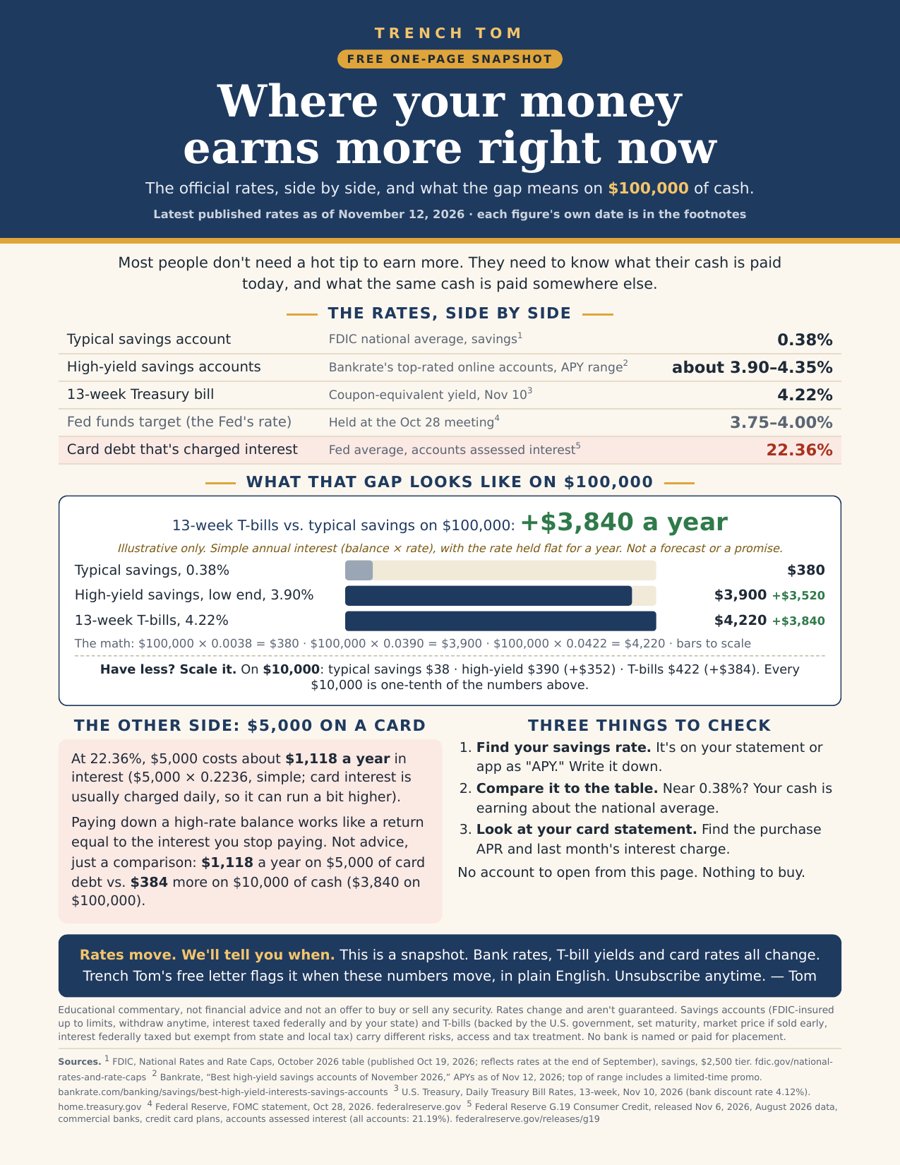
As of November 12, 2026, the Federal Reserve's most recent policy statement was issued on October 28, 2026. The Federal Open Market Committee maintained its target range for the federal funds rate at 3.75% to 4.00%. On November 10, 2026, the U.S. Treasury reported a 4.22% coupon-equivalent rate for the 13-week Treasury bill. Those figures are related through the broader short-term rate environment, but they are not the same rate.
Key facts
- The Federal Reserve changes the stance of monetary policy partly by raising, lowering or maintaining its target range for the federal funds rate.
- The federal funds rate concerns overnight borrowing in the banking system. It is not a consumer savings rate.
- Banks and credit unions decide what APY to offer depositors.
- Treasury bill yields come from prices established at Treasury auctions and in market trading.
- Bill prices and yields move in opposite directions: a lower purchase price means a higher yield, all else equal.
- Savings APYs and Treasury bill yields can move before a Fed meeting because institutions and markets respond to expectations.
- They may move again after a meeting if the decision, statement or new data changes those expectations.
- On October 28, 2026, the Fed maintained a federal funds target range of 3.75% to 4.00%.
- The Treasury's November 10, 2026 bill table showed a 4.22% coupon-equivalent rate for the 13-week bill.
What rate does the Federal Reserve actually control?
The Federal Reserve does not announce one universal interest rate for every loan, savings account, certificate of deposit or government security.
The Federal Open Market Committee sets a target range for the federal funds rate. The federal funds market is where eligible institutions borrow and lend reserve balances overnight. The Fed then uses policy tools to keep the effective federal funds rate inside that range.
One important tool is the interest rate paid on reserve balances. The Fed can adjust this administered rate to put upward or downward pressure on short-term market rates. It also has an overnight reverse repurchase facility and other tools available for policy implementation.
The Fed describes the process as a chain. Policy actions influence short-term rates and broader financial conditions. Those conditions can then affect household and business decisions.
At its October 28, 2026 meeting, the FOMC maintained the federal funds target range at 3.75% to 4.00%.
That does not mean every short-term rate must equal 3.75% or 4.00%. The target range creates a reference point and influences the opportunity cost of money across the financial system. Other rates still reflect their own markets, terms, risks and business decisions.
A useful way to think about it is this: the Fed changes the pressure in the system, but it does not turn every faucet itself.
Why do savings account APYs move after Fed decisions?
A savings account is a bank or credit union product. The institution sets its own annual percentage yield, or APY. The guide to APY versus the interest rate on a savings account explains how compounding connects those two disclosed numbers.
Fed policy matters because it influences the rates available across short-term funding and cash markets. When short-term market rates rise, a bank may have more reason to pay depositors a higher rate. The bank may need deposits to support lending, replace other funding or compete with money market funds, Treasury bills and rival banks.
But a bank does not have to match a Fed move point for point.
Its decision can depend on:
- how many deposits it already has;
- whether it wants more cash from customers;
- how aggressively it is competing for new accounts;
- what it earns on loans and securities;
- the cost of its other funding sources;
- customer sensitivity to rate changes;
- balance tiers, withdrawal rules and promotional terms.
This is why two savings accounts can carry very different APYs during the same week. A bank with plenty of stable deposits may see little reason to raise its rate. An online bank trying to attract cash may react more quickly. A promotional account may offer a high rate only under specific conditions.
The same uneven pattern can appear when the Fed lowers rates. Some banks cut deposit APYs quickly because their funding costs are falling. Others move more slowly because they want to retain customers or remain competitive.
The direction is often connected to Fed policy. The amount and timing are bank decisions. That variable-rate exposure differs from a plain fixed-rate CD's term commitment; the guide to CDs versus high-yield savings accounts compares rate certainty with access, penalties and renewal terms.
Why do Treasury bill yields move when Fed policy changes?
Treasury bills are short-term obligations of the U.S. government. They generally mature in one year or less. Unlike a savings account, a bill is a marketable security.
Bills are sold at auction. Investors submit bids, and the auction process helps establish the price and investment rate. After issuance, bills can also trade in the secondary market. Buyers and sellers continually reassess what a bill is worth.
A traditional Treasury bill does not make regular coupon payments. Instead, it is generally issued or purchased for less than its face value. At maturity, the holder receives the face value. The difference between the purchase price and the maturity value produces the return, subject to the specific calculation method and whether the bill is held to maturity.
Price and yield move in opposite directions. If investors demand a higher return, they will generally pay a lower price for the same maturity value. That lower price produces a higher yield. If buyers are willing to accept a lower return, stronger demand can push the price up and the yield down.
Fed policy affects this market because very short-term Treasury securities compete with other short-term uses of cash. The federal funds target range and the Fed's implementation tools help anchor overnight rates. Expectations for future policy also affect what investors are willing to pay for a bill that matures weeks or months later.
Still, the Fed does not assign the bill's yield. Auction demand, secondary-market trading, expected policy, inflation expectations, liquidity, the amount of bills available and other market conditions all matter.
That is why a 13-week bill rate can sit above or below particular Fed-administered rates. It is also why the bill yield can change on a day when the FOMC makes no announcement.
Can savings rates and Treasury bill yields move before a Fed meeting?
Yes. Financial markets look forward.
Suppose investors broadly expect the FOMC to lower its target range at an upcoming meeting. Buyers may become willing to accept lower yields on short-term Treasury bills before the meeting happens. Bill prices can rise and yields can fall as that expectation becomes reflected in the market.
The opposite can happen if investors expect higher policy rates. Bill prices may fall and yields may rise before the official decision.
Banks can also act early. A bank may lower a savings APY because competing market rates have already declined, even though the Fed has not yet changed its target. Another bank may keep its APY unchanged until after the meeting. A third may move for reasons that have little to do with that particular meeting.
Expectations can change quickly when new information arrives. Inflation data, employment reports, Fed communications, economic growth, financial stress and demand for safe short-term assets can all alter how markets price the future. Inflation headlines also need careful labels: month-over-month and year-over-year inflation measure different windows, so they can move in different directions without contradicting each other.
Then the announcement arrives. If the Fed does exactly what markets expected and gives no major surprise, the immediate rate reaction may be small. If the decision or statement changes expectations, market rates may move sharply even when the current target range is unchanged.
This explains an apparent contradiction that often confuses savers: “The Fed held rates steady, but Treasury bill yields moved.” There is no contradiction. The market was responding to new information about the path ahead, not only the current target range. Those collective expectations about the path are visible in the shape of the yield curve, which is described in the guide to what the yield curve shows and how to read it.
How do savings accounts and 13-week Treasury bills compare?
A savings account and a 13-week Treasury bill can both hold cash for a relatively short period, but they work differently. The headline rate is only one part of the comparison.
| Feature | Savings account | 13-week Treasury bill |
|---|---|---|
| Who sets the rate or yield? | The bank or credit union sets the APY | Auction and market prices determine the yield |
| Does the Fed set it directly? | No | No |
| How does the return work? | Interest is credited under the account's terms and may compound | The bill is generally bought below face value and pays face value at maturity |
| Can the rate change while you hold it? | Usually yes, because most savings APYs are variable | The maturity value is fixed for a bill held to maturity, though its market value changes if sold early |
| Access to cash | Withdrawals are generally available under account rules | Cash is committed until maturity unless the bill is sold in the secondary market |
| Principal protection | Eligible deposits may be insured within applicable federal limits and rules | Backed by the full faith and credit of the U.S. government |
| Market-price risk | No daily market price for an ordinary deposit | Selling before maturity can produce a gain or loss because the market price changes |
| Taxes | Interest is generally subject to federal and applicable state and local income taxes | Interest is subject to federal income tax but generally exempt from state and local income taxes |
| Rate shown | APY reflects compounding over a year under stated assumptions | Treasury publishes several bill-rate measures; they are not automatically identical to a bank APY |
The tax row is a general description, not tax advice. Individual circumstances and account structures can change tax treatment.
The comparison also highlights a measurement problem. A savings account advertises APY. The Treasury bill table includes bank-discount rates and coupon-equivalent rates. Those figures use different conventions. The guide to Treasury bill discount rates and investment rates shows how the formulas use different denominators and day counts. A 4.22% coupon-equivalent bill rate and a 4.22% savings APY should not be treated as perfectly interchangeable without considering compounding, timing, purchase price, taxes, account terms and access to the money.
What does the November 2026 rate snapshot tell us?
The latest official figures available for this article show the relationship without suggesting that the rates should match.
On October 28, 2026, the FOMC maintained its target range for the federal funds rate at 3.75% to 4.00%.
The U.S. Treasury's daily bill rates for November 10, 2026 showed the following for the 13-week bill:
- Bank-discount rate: 4.12%
- Coupon-equivalent rate: 4.22%
The coupon-equivalent figure provides a bond-style annualized yield measure. It is useful for comparison, but it is still not the same thing as a savings account APY.
The 4.22% figure was also above the top of the Fed's 3.75% to 4.00% target range. That does not mean the Fed lost control of its policy rate. The target applies to overnight federal funds transactions. A 13-week Treasury bill has a longer term and is priced by investors based on the conditions and expectations relevant to that maturity.
The snapshot is just that: a snapshot. A savings APY can be changed by the bank. A newly auctioned bill can carry a different rate. A bill already in the market can trade at a different price. Current numbers should always be paired with their exact date and product terms.
If you want the main cash rates on one dated page, get the free Trench Tom rate snapshot. It places savings, Treasury bills, the Fed and credit-card rates side by side, with the source and date for each number. It is an educational reference, not a statement that any account or security is suitable for you.
What should you check when comparing cash rates?
Start by confirming that you are comparing the same kind of number. APY, annualized yield, coupon-equivalent rate and bank-discount rate are not interchangeable labels.
Then check the practical terms:
- Date. Rates can change. A figure without a date may be stale.
- Access. A savings account usually offers ongoing access. A bill has a maturity date and may need to be sold if cash is required earlier.
- Variability. A savings APY can change after the account is opened. A bill's maturity payment does not change if it is held to maturity, but its market value can change before then.
- Minimums and tiers. Some deposit rates apply only to certain balances or require other conditions.
- Insurance or backing. Verify the institution, ownership category, applicable insurance rules and coverage limits for a deposit. Understand the federal backing of Treasury securities separately.
- Taxes. Federal, state and local treatment may differ.
- Renewal risk. A short-term bill eventually matures. The rate available for the next bill may be higher or lower. A savings account can also reset its APY at any time.
- Fees and friction. Account fees, transfer delays, early-sale spreads and platform procedures can affect the real experience.
None of these checks produces one universally correct answer. They simply prevent a headline rate from doing all the thinking.
What happens when the Fed cuts rates but your bank does not move?
A Fed cut changes the short-term rate environment, but a bank still chooses its deposit price. Sometimes a bank keeps an APY unchanged for a while. It may be trying to retain customers. It may be waiting for competitors. It may have a promotional rate with a fixed end date. Or the account's rate may already be low enough that management sees no need to change it immediately.
The reverse can happen too. A bank may cut its APY before the Fed moves because market rates have already fallen. It may also reduce the rate by more or less than the Fed's change.
This is why the useful question is not simply, “Did the Fed cut?” The useful questions are:
- What does this account pay today?
- Is that rate variable or promotional?
- When was it last updated?
- What do comparable short-term options pay on the same date?
- What access, insurance, maturity and tax differences come with each option?
The Fed decision is important context. The account's actual terms are the number that reaches your statement.
Deposit rates are only one side of household rate transmission. Credit card interest is calculated from the card's APR and daily balance, so borrowing costs can remain high even when cash rates move.
Frequently Asked Questions
1. Does the Federal Reserve set savings account interest rates?
No. Banks and credit unions set their own deposit rates. Fed policy influences the short-term rate environment, but each institution decides whether, when and how much to change its APY.
2. Does the Fed set Treasury bill yields?
No. Treasury bill prices and yields are established through Treasury auctions and market trading. Fed policy affects short-term financial conditions and expectations, which can influence those prices.
3. Why did my savings APY stay the same after a Fed decision?
Your bank may already have enough deposits, face limited competitive pressure or be waiting to see how market rates develop. Deposit-rate changes are business decisions, not automatic copies of FOMC moves.
4. Why can Treasury bill yields change before the Fed meets?
Investors price expected future conditions. If expectations for Fed policy, inflation, growth or demand for safe assets change, bill prices and yields can move before an official announcement.
5. What was the federal funds target range on November 12, 2026?
The most recent FOMC statement, dated October 28, 2026, maintained the target range at 3.75% to 4.00%.
6. What was the 13-week Treasury bill rate on November 10, 2026?
The Treasury reported a 4.12% bank-discount rate and a 4.22% coupon-equivalent rate for the 13-week bill.
7. Is a Treasury bill rate the same as a savings APY?
No. The calculations, compounding assumptions, liquidity, tax treatment and product structures differ. Compare the underlying terms, not just two percentages.
8. Can I lose money on a Treasury bill?
A bill held to maturity pays its stated face value, subject to U.S. government payment. If you sell before maturity, its market price may be above or below what you paid. Procedures and tax consequences also matter.
Source notes
- Federal Reserve, “Federal Reserve issues FOMC statement,” October 28, 2026. Supports the current federal funds target range of 3.75% to 4.00%. Read the FOMC statement.
- Federal Reserve, “The Fed Explained: Monetary Policy.” Supports the description of the federal funds target range, interest on reserve balances, the overnight reverse repurchase facility and policy transmission. Read the Federal Reserve explainer.
- U.S. Department of the Treasury, “Daily Treasury Bill Rates,” November 2026. Supports the November 10, 2026 13-week bill bank-discount rate of 4.12% and coupon-equivalent rate of 4.22%. Read the Treasury rate table.
Financial disclaimer: Trench Tom provides educational commentary only. Nothing in this article is a recommendation, offer, promise of return or individualized financial, investment, tax or legal advice. Verify current rates and terms with official sources and relevant institutions. Consider consulting a qualified professional about your circumstances.