The words money market appear on bank accounts and investment funds. That shared name can hide the most important part of the comparison: what you actually own.
One is a deposit. The other is an investment. A check-writing feature, familiar financial brand or similar percentage does not erase that difference. The CFPB's money market account explanation makes this distinction explicit.
This guide compares ordinary money market deposit accounts with conventional money market mutual funds. It does not rank products or quote today's best rate. Exchange-traded money market products need a separate trading-price review; they are outside this comparison.
Financial disclaimer: General education only, not financial, investment, tax or legal advice. Product terms and protection rules vary. No example is an offer, a recommendation or a promise of earnings.
Quick answer: What is the difference between a money market account and fund?
A money market account is a bank or credit-union deposit. A money market fund holds investments and issues shares. Eligible deposits can receive FDIC or federal credit-union insurance within applicable rules; fund shares do not receive that deposit protection. Deposit offers commonly use APY, while funds commonly quote an annualized seven-day yield. Neither label promises an unchanged future rate. Compare the legal product, coverage, access process, costs and yield definition before comparing percentages. A brokerage cash balance may use either a deposit sweep or a fund, so inspect the actual holding rather than the app's name. See the SEC's cash-sweep guide.
Key facts
- A money market deposit account and a money market mutual fund are different products.
- FDIC coverage applies to eligible deposits at insured banks, not mutual fund shares.
- A fund's aim to maintain a stable share price is not deposit insurance.
- APY includes specified compounding assumptions; an ordinary seven-day yield is a different measure.
- A quoted yield is not a full-year earnings guarantee.
- Access depends on the account agreement, fund terms and platform procedures.
- SIPC protection concerns missing customer assets at a failed member broker, not investment losses.
The official and provider definitions supporting these distinctions are linked below. Sources were checked November 26, 2026; the publication dates of older guides are preserved in the source notes.
What do you own with each product?
Start with the document that creates the relationship.
For a deposit account, request the deposit agreement and rate disclosure. For a fund, request the prospectus and identify the exact fund and share class. Do not stop at a screen that says cash or money market.
The CFPB guide describes money market accounts as accounts offered by banks and credit unions. It also notes that transaction limits and minimum deposits may apply. A fund account remains an investment even when check writing is available.
The SEC's money market fund overview explains that these funds hold liquid, short-term debt, cash and cash equivalents. Fund income is distributed as dividends. Broad categories include government, prime and tax-exempt funds. Those names identify different investment mandates, not interchangeable packages.
Use this first-pass worksheet:
| Question | Deposit account | Conventional mutual fund |
|---|---|---|
| What document should I request? | Deposit agreement | Prospectus and share-class details |
| What identity should I record? | Legal bank or credit union | Fund, share class and account provider |
| What percentage should I label? | APY and interest rate | Yield definition and measurement date |
| What protection should I verify? | Deposit or share insurance | Investment risks and brokerage custody protection |
| What exit process should I map? | Withdrawal and transfer | Redemption and transfer |
These are research fields, not a scorecard. Leave a field blank when the provider has not supplied the answer. An honest unknown is more useful than assuming that two products work alike.
Which product has deposit insurance?
Eligible money market deposit accounts at FDIC-insured banks are covered within the insurance rules. The standard amount is $250,000 per depositor, per insured bank, for each ownership category. Mutual funds are not covered. The FDIC also combines deposits in the same category at the same bank rather than assigning a separate limit to each product. See Deposit Insurance At A Glance.
Here is a hypothetical aggregation example. Assume one person owns both accounts individually, with no beneficiaries, at the same insured bank. Assume these are the only deposits in that ownership category and ignore additional accrued interest:
- Savings balance: $180,000.
- Money market deposit balance: $90,000.
- Combined deposits: $180,000 + $90,000 = $270,000.
- Amount above the standard limit: $270,000 − $250,000 = $20,000.
Calling the second account a money market account does not create another limit. Different ownership arrangements require a different calculation. Use the official coverage tools instead of extending this simple illustration to trusts or joint accounts.
At a federally insured credit union, the relevant system is NCUA share insurance. The NCUA insurance FAQ explains eligible accounts, ownership categories and aggregation. Mutual funds sold through a credit union are not share-insured merely because the credit union offers access to them.
For a coverage review, collect institution names, balances, ownership titles and beneficiary information before doing arithmetic. Keep accrued income in view. The question is not just whether a financial institution displays an insurance logo. It is whether this specific holding qualifies under the applicable rules.
Can a money market fund lose value, and does SIPC cover that?
A stable price objective is not a guarantee.
The SEC fund overview explains that many retail and government money market funds seek a stable net asset value, commonly $1 per share. Net asset value, or NAV, is fund assets minus liabilities, expressed per share. Institutional prime and institutional tax-exempt funds use floating NAVs. A stable-NAV fund can also lose value if it fails to maintain its price.
Separate that investment risk from a broker's custody function. According to SIPC's protection guide, money market mutual funds are securities for SIPC purposes. SIPC works to restore missing customer assets in a member brokerage liquidation. It does not reimburse a decline in an investment's value.
That distinction answers two different questions:
- What happens if the investment itself loses value?
- What happens if the brokerage fails and customer assets are missing?
Do not accept an answer to the second question as proof that the first risk has disappeared.
The same discipline applies to a government-oriented fund. Read the fund's mandate and risk disclosure. Do not treat ownership of fund shares as identical to owning an individual Treasury security with a specified maturity payment. Our explanation of Treasury bills, notes and bonds provides the separate security-level framework.
Write down the precise protection being described. Deposit insurance, custody protection and an investment's underlying holdings belong on different lines of the worksheet.
How do APY and seven-day yield differ?
Both are annualized percentages. They are not the same calculation.
The CFPB's Regulation DD definition defines APY using the interest rate and compounding frequency over a 365-day period under its calculation rules. That is why deposit comparisons should keep APY separate from the stated interest rate. The guide to APY versus savings-account interest rate walks through that distinction.
A fund's seven-day yield uses a recent income window and expresses it at an annual rate. For example, Schwab's yield definition says its seven-day yield uses the previous seven days' average income, assumes income is not reinvested and reflects applicable waivers. This is a definition, not an endorsement or a quoted offer.
The percentage is not what the investor earns in seven days. Nor does it lock income for the next year. Read whether the displayed measure is ordinary yield, effective yield or something else, and whether expenses and waivers are reflected.
A simple illustration shows why labels matter. Assume a hypothetical constant annualized income rate of 4.00%, a $10,000 balance and a 30-day period. Ignore reinvestment, taxes, withdrawals and additional account charges:
Illustrative income = $10,000 × 0.04 × 30 ÷ 365 = about $32.88.
This is simple annualized-rate arithmetic. It is not an APY calculation and not a forecast of a fund distribution. Actual daily income can change.
For a useful comparison sheet, record the percentage, exact measure, as-of date, compounding treatment and cost treatment together. A percentage without those labels leaves the comparison unfinished.
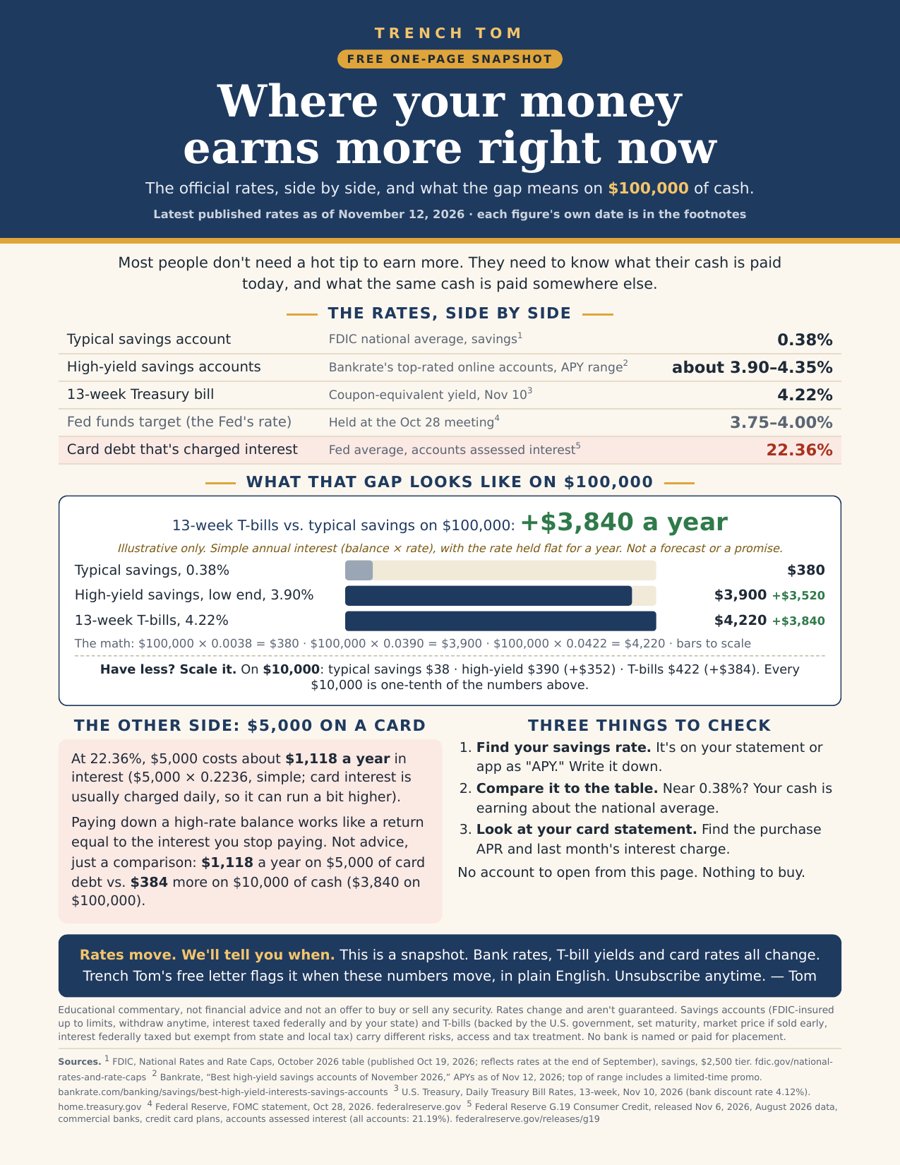
For broader official-rate context, the free one-page Trench Tom rate snapshot is a companion reference, not a product recommendation.
How quickly can you get the money back?
Separate access to an account from arrival of spendable money elsewhere.
Conventional mutual fund shares generally redeem through the fund or a broker at NAV on business days, as the SEC overview explains. That description does not establish the exact withdrawal deadline or bank-arrival time for every platform. A deposit account likewise needs its own transaction rules checked, as the CFPB account guide notes.
Ask the provider to walk through a specific scenario: a withdrawal requested after the usual processing cutoff, with the destination at another institution. Then ask what changes on a weekend or holiday. Record the answer instead of using the word liquid as a substitute for timing.
Useful questions include:
- Must I place a redemption order myself?
- Does the platform automatically liquidate this particular fund for payments?
- What cutoff applies to my order?
- Is the balance available for trading, withdrawal or both?
- Are recent deposits subject to a hold?
- When is an external transfer expected to arrive?
- What charges could apply?
Also read the stress provisions. The SEC's November 4, 2024 bulletin describes liquidity fees and exceptional circumstances permitting permanent suspension of redemptions and liquidation. Fee requirements differ by fund category; a blanket claim that every fund always redeems without fees is wrong.
Do not confuse those provisions with a CD's early-withdrawal terms. Our CD versus high-yield savings comparison explains a different form of access constraint: a deposit contract with a maturity date.
Why can income change, and which costs should you check?
For a variable-rate deposit, the disclosure should explain that the rate can change, how it is determined and how often it may change. That comes from Regulation DD's account-disclosure requirements. The opening APY is not automatically a term-long commitment.
Fund income also changes. The SEC money market bulletin explains that yields generally reflect short-term interest rates over time. That relationship does not supply an exact future income path for a particular shareholder.
Rather than predicting which product will pay more, ask what would need to remain unchanged for a comparison to hold. Keep those assumptions visible. A useful comparison has a date and a defined time window, not just two percentages circled in an advertisement.
For deposits, request minimum-balance, fee, tier and promotional-rate details alongside the rate disclosure. For funds, read the prospectus's expenses and share-class terms. The SEC overview notes that fund costs vary. Where a yield is already net of fund expenses, do not subtract the same expense a second time; separately identify any account-level charge not included in that measure.
Taxes are another distinct field. IRS Publication 550, the 2025 edition, distinguishes money market fund dividends from bank money market account interest. The edition is identified because an older tax publication is not a new release. It does not determine anyone's individual tax result.
Keep the comparison pretax unless the account type, fund reporting and applicable tax treatment have been checked. A tax-exempt label alone is not enough to calculate a household's after-tax outcome.
What if the money appears in a brokerage cash sweep?
A brokerage account is the container. Find out what holds the cash inside it.
The SEC cash-sweep bulletin, dated May 14, 2025 describes bank sweeps, money market fund sweeps and cash left at the investment firm. Those arrangements have different protections and terms.
Ask for the exact destination of uninvested cash. If it is a bank sweep, identify the receiving banks and check other deposits you already hold there. If it is a fund sweep, identify the fund and share class. If cash stays with the broker, ask whether it earns interest and what protection applies.
FINRA's guide to managing brokerage cash recommends checking the account statement or agreement to identify the program. It also explains that the default is not necessarily the only available arrangement.
A practical review can be one page: current cash balance, actual holding, current rate label, protection, costs and exit process. Add a line for whether a change requires a manual instruction. Do not infer that an action occurred because another option is advertised in the same app.
For example, if a statement lists a fund ticker but the marketing screen highlights a bank-sweep rate, ask which one applies to your balance. Resolve the mismatch before using either percentage in a comparison.
What should you verify before comparing offers?
Use this closing checklist to organize the evidence rather than select a universal winner:
- Name the product: deposit account, conventional mutual fund or another structure.
- Record the legal institution, exact fund and share class where relevant.
- Save the dated agreement, disclosure or prospectus.
- Copy the rate label exactly; distinguish APY from seven-day yield.
- Note whether the rate can change and which assumptions support the illustration.
- Verify deposit coverage or custody protection without treating them as equivalent.
- Add related deposits when checking the relevant insurance category.
- Record minimums, fees, waivers and promotional conditions.
- Map the withdrawal or redemption path through to the destination account.
- Leave tax treatment unresolved until the relevant documents are checked.
Then write a short summary in your own words: what is owned, what can change, what protection applies and how the money comes back. If that summary cannot be completed without guessing, the offer is not yet understood.
The point is not to find a winner from the name money market. It is to prevent the name from hiding the contract.
Frequently Asked Questions
1. Is a money market account the same as a money market fund?
No. A money market account is a deposit product. A money market mutual fund is an investment that issues shares. Similar names and payment features do not make their protections identical.
2. Are money market funds FDIC insured?
No. FDIC insurance covers eligible deposits at insured banks, not mutual fund shares. A fund offered through a bank is still a fund.
3. Does each money market deposit account have a separate insurance limit?
Not automatically. FDIC coverage combines deposits at the same bank within the same ownership category. Different account numbers do not by themselves create additional coverage.
4. Does SIPC reimburse a money market fund loss?
Not a loss caused by falling investment value. SIPC addresses missing customer assets in a failed member brokerage's liquidation; it is not insurance against poor investment performance.
5. Does a seven-day yield show what I earn in one week?
No. It is an annualized measure based on a recent seven-day income period. Read the provider's definition, expense treatment and reinvestment assumptions.
6. Can I withdraw from either product immediately?
Do not assume so. Check account withdrawal rules, fund redemption procedures, cutoffs, holds and transfer timing. Access within one platform is not the same as arrival at an outside bank.
7. Is a stable $1 fund price guaranteed?
No. A stable NAV is an objective, not deposit insurance. A fund can lose value, and some money market fund categories use floating NAVs.
8. Is the brokerage default cash option always a money market fund?
No. The default can be a bank sweep, fund sweep or another cash arrangement. Check the statement and agreement for the actual holding and applicable rate.
Source notes
All sources were checked November 26, 2026. This is a product-mechanics guide, not a current-yield survey. The illustrations are hypothetical.
- CFPB, What is a money market account?, reviewed August 28, 2026. Deposit-versus-fund distinction, minimums and transaction terms. Read the account guide.
- FDIC, Deposit Insurance At A Glance, updated April 1, 2024. Eligible deposits, exclusions, the standard limit and aggregation. Read the coverage guide.
- NCUA, Frequently Asked Questions About Share Insurance, live guide. Federal credit-union coverage and mutual-fund exclusion. Read the insurance FAQ.
- SEC Investor.gov, Money Market Funds, live educational guide. Holdings, dividends, fund categories, NAV, redemption and expenses. Read the fund overview.
- SEC Investor.gov, Money Market Funds: Investor Bulletin, November 4, 2024. Changing yields, losses, liquidity fees and exceptional liquidation provisions. Staff education, not a rule itself. Read the bulletin.
- SIPC, What SIPC Protects, live guide. Custody protection, treatment of money market funds as securities and exclusion of market losses. Read the protection explanation.
- CFPB, Regulation DD, current displayed text. APY definition and variable-rate account disclosures. Read section 1030.2 and section 1030.4.
- Charles Schwab, Money Market Funds, live provider FAQ. Seven-day yield definition, non-reinvestment assumption and waiver treatment. Used for methodology, not product selection. Read the yield definition.
- IRS, Publication 550, 2025 edition. General distinction between fund dividends and deposit interest; not individual tax advice. Read the publication.
- SEC Investor.gov, Cash Sweep Programs for Uninvested Cash in Your Investment Accounts, May 14, 2025. Sweep types and differences in protection. Read the sweep bulletin.
- FINRA, Don't Lose Interest: Managing Cash in Your Brokerage Account, August 21, 2023. Statements, default programs and cash-management review. Read FINRA's guide.
Financial disclaimer: Trench Tom provides educational commentary only. Verify current product disclosures, costs, access rules and coverage with the responsible institution or authority. Nothing here guarantees a return or identifies a suitable product for any individual.