Treasury bills, notes and bonds are all marketable debt issued by the U.S. Treasury. They share the same federal backing. They do not share the same timeline or cash flow.
A bill can mature in a few weeks. A bond can run for 30 years. Bills usually produce interest through the gap between the purchase price and face value. Notes and bonds pay fixed interest every six months.
Those differences affect access to cash, price movement, reinvestment and the meaning of the quoted yield.
Financial disclaimer: This article is general educational commentary, not financial, investment, tax or legal advice. Treasury prices, yields, taxes, auction terms and account procedures can change. Verify the current security and official terms before making a financial decision.
Quick answer: What is the difference between Treasury bills, notes and bonds?
Treasury bills are short-term securities that mature in 4 to 52 weeks. They are generally sold at a discount or at face value and pay face value at maturity. Treasury notes mature in 2, 3, 5, 7 or 10 years. Treasury bonds mature in 20 or 30 years. Notes and bonds pay a fixed rate of interest every six months and return face value at maturity.
All three are marketable Treasury securities, so they can be sold before maturity through a bank, broker or dealer. An early sale happens at the current market price, which may be above or below the amount paid.
Key facts
- Treasury bills currently have terms of 4, 6, 8, 13, 17, 26 or 52 weeks.
- Treasury notes currently have terms of 2, 3, 5, 7 or 10 years.
- Treasury bonds currently have terms of 20 or 30 years.
- Bills generally pay interest at maturity through the difference between purchase price and face value.
- Notes and bonds pay fixed interest every six months.
- The minimum purchase at a Treasury auction is $100, with additional amounts in $100 increments.
- Bills, notes and bonds are marketable. They can be sold before maturity, but the sale price can change.
- A longer maturity usually creates more sensitivity to changes in market interest rates, all else equal.
- Treasury interest is subject to federal income tax but exempt from state and local income taxes under Treasury's general rule.
What are Treasury bills, notes and bonds?
All three are debt instruments. The federal government borrows money by issuing them. The buyer provides cash. Treasury promises the security's stated payments under its terms.
They are called marketable securities because ownership can be transferred and the security can be sold in the secondary market. This separates them from U.S. savings bonds, which are nonmarketable and follow different purchase, redemption and interest rules.
The main naming rule is maturity:
| Treasury security | Current standard terms | How interest is normally paid | Principal payment |
|---|---|---|---|
| Treasury bill | 4, 6, 8, 13, 17, 26 or 52 weeks | Difference between purchase price and face value, paid at maturity | Face value at maturity |
| Treasury note | 2, 3, 5, 7 or 10 years | Fixed interest every six months | Face value at maturity |
| Treasury bond | 20 or 30 years | Fixed interest every six months | Face value at maturity |
A 52-week bill and a 2-year note sit close together on the calendar, but their cash flows differ. The bill generally has no semiannual coupon. The note does.
A 10-year note and a 20-year bond use the same basic coupon structure. Treasury gives them different names because their maturity ranges differ.
Treasury also issues TIPS and floating rate notes. Those securities have different interest mechanics. They are outside this bills-versus-notes-versus-bonds comparison.
How do the interest payments differ?
A traditional Treasury bill is a discount security. Suppose a bill has a $1,000 face value and the auction price is $990. If it is held to maturity, Treasury pays $1,000. The $10 difference is the bill interest before taxes and other transaction effects.
The displayed percentage requires care. Treasury bill data can show a bank discount rate and an investment or coupon-equivalent rate. They use different formulas. The guide to Treasury bill discount rates versus investment rates explains why the two percentages can describe the same bill without being equal.
Notes and bonds work differently. Treasury sets a fixed annual interest rate at auction. The security pays half of that annual amount every six months, based on face value.
Consider a simplified $10,000 note with a 4.00% fixed interest rate:
- Annual coupon interest: $10,000 × 4.00% = $400
- Semiannual payment: $400 ÷ 2 = $200
- Number of payments on a 10-year note: 20
- Total coupon interest over 10 years: $4,000, before federal tax, assuming every payment is made as scheduled
- Principal returned at maturity: $10,000
This is an illustration, not a current auction quote or return promise. It assumes the note is held to maturity. It also leaves out the price paid, reinvestment of coupon payments, taxes and any transaction costs.
The price matters because a note or bond can be issued at par, below par or above par. A $10,000 face amount does not guarantee a $10,000 purchase price at auction or in the secondary market.
Why can a Treasury note or bond trade above or below face value?
The fixed coupon stays the same. Market yields do not.
Suppose an older note pays a 3% coupon. If comparable new notes later offer higher yields, buyers will generally pay less for the older note. Its fixed payments have become less attractive relative to the newer market. A lower price raises the yield available to the next buyer.
The reverse can happen when market yields fall. An older security with a higher coupon may become more valuable, so its price can rise above face value.
TreasuryDirect summarizes the auction relationship this way:
- When yield to maturity is greater than the coupon rate, price is below par.
- When yield to maturity equals the coupon rate, price is at par.
- When yield to maturity is less than the coupon rate, price is above par.
This does not mean the coupon changes. The coupon is fixed for the life of an ordinary note or bond. The price changes so the security's remaining payments line up with the yield buyers require.
Bills follow the same broad price-and-yield direction. A lower bill price generally means a higher yield, all else equal. The cash-flow format is different because a bill normally pays at maturity instead of sending coupons every six months.
Three terms should stay separate:
- Coupon rate: the fixed annual interest rate paid on the face value of a note or bond.
- Current price: what a buyer pays now at auction or in the secondary market.
- Yield to maturity: an annualized return measure based on the price and scheduled payments, assuming the security is held to maturity and the calculation's assumptions are met.
A high coupon does not automatically mean a high yield. A high purchase price can reduce the yield. A low coupon security bought at a large discount can have a higher yield than its coupon rate.
Which maturity creates more price risk?
Maturity is one of the main drivers of interest-rate sensitivity.
A short bill will return face value soon. There is less time for the difference between its old rate and the current market rate to matter. A 30-year bond has decades of fixed payments ahead. A change in market yields can alter the present value of those distant payments much more.
That is why long-term Treasury prices usually move more than short-term Treasury prices when yields change by a similar amount. The exact price response also depends on the coupon, yield, payment schedule and time remaining.
This creates two different risk questions:
- If held to maturity: Will the scheduled interest and principal be paid under the Treasury's terms?
- If sold early: What price will another buyer pay on the sale date?
Federal backing addresses Treasury's payment obligation. It does not lock the resale price.
A holder who must sell a long bond after yields rise may receive less than the purchase price. A holder who sells after yields fall may receive more. Either result can be affected by accrued interest, bid-ask spreads, fees and settlement procedures.
Short maturities carry another tradeoff: reinvestment risk. A 13-week bill returns cash quickly. The next bill available may have a higher or lower yield. A longer note or bond fixes its coupon for longer, but its market price can swing more before maturity.
The Federal Reserve does not directly set every Treasury yield. Policy changes influence the rate environment, while auctions and market trading determine security prices. The explanation of how Fed rate changes affect savings accounts and Treasury bills follows that transmission process.
Plotting those market-determined yields side by side, from the shortest bill to the longest bond, produces the yield curve. The guide to what the yield curve shows and how to read its shape explains how the maturities compared here form that snapshot.
What happens if you hold the security to maturity?
At maturity, a bill pays its face value. A note or bond pays its face value after making its final scheduled coupon payment, subject to U.S. government payment.
Holding to maturity removes the need to accept an interim market price. It does not remove every practical issue.
Check these items:
- Purchase price. A note bought above face value can return less principal than its purchase price at maturity, even though all promised payments were made.
- Coupon cash flow. Notes and bonds send interest every six months. That cash may be spent or reinvested at rates that are not known in advance.
- Inflation. Ordinary bills, notes and bonds have nominal payments. Rising prices can reduce what those dollars buy.
- Taxes. Interest is generally subject to federal income tax even though Treasury says it is exempt from state and local income taxes.
- Timing. The maturity date must fit the date when the cash is needed.
- Account procedures. TreasuryDirect and brokers can use different settlement, reinvestment and cash-transfer processes.
The phrase “held to maturity” is therefore a cash-flow description, not a universal statement that a security is suitable or risk-free in every sense.
A person can receive every scheduled dollar and still face an opportunity cost if market yields rose after purchase. A person can also lock in a coupon that later looks attractive when market yields fall. Those are comparisons with later alternatives, not changes to the original contract.
What happens if you sell before maturity?
A marketable Treasury security can be sold before maturity through a bank, broker or dealer. The buyer pays the market price available at that time.
TreasuryDirect does not provide a direct sell button. A security held there generally must be transferred to a bank, broker or dealer for sale. TreasuryDirect also states that a newly issued marketable security generally must remain in the account for 45 calendar days before it can be transferred or sold. That restriction means a 4-week bill bought at original issue in TreasuryDirect matures before it can be transferred.
A broker-held security can have different operational rules. The broker may provide a live or delayed price, show an estimated gain or loss, charge a fee, or earn compensation through the trading spread. Read the platform's terms.
Before an early sale, identify:
- the security's CUSIP;
- face value and current position size;
- coupon rate, if any;
- maturity date;
- original purchase price;
- current bid price and quoted yield;
- accrued interest on a note or bond;
- fees or spread;
- settlement date;
- federal tax consequences of interest, gain or loss.
Do not compare only the current price with face value. If the security has already paid coupons, those cash flows are part of the holding-period result. Tax reporting can also separate interest from a gain or loss.
How should you compare bills, notes and bonds?
Start with the job the money must do. Then compare the mechanics.
| Question | Why it matters |
|---|---|
| When will the cash be needed? | A maturity after the spending date can force an early sale. |
| Are periodic payments useful? | Notes and bonds pay every six months; bills generally pay at maturity. |
| Can the value move before maturity? | Every marketable Treasury can change in price. Longer maturities are generally more sensitive. |
| Is the quoted number a coupon, discount rate or yield? | The labels use different formulas and answer different questions. |
| What happens at maturity? | Face value is paid, but the original purchase price may have been above or below face value. |
| What is the reinvestment plan? | Short bills mature quickly, while note and bond coupons also create cash to reinvest. |
| Where will the security be held? | TreasuryDirect and broker accounts have different sale and transfer procedures. |
| What taxes apply? | Treasury interest is generally federally taxable and exempt from state and local income taxes. |
| What does an early exit cost? | Market price, spread, fees and taxes can change the result. |
A rate comparison should use the same observation date and a compatible measure. A bill's bank discount rate should not be placed beside a note's coupon rate and treated as an even contest.
The same warning applies to deposit accounts. A savings APY includes a compounding convention and usually comes with variable-rate account terms. The guide to APY versus the interest rate on a savings account explains that measurement. Deposit insurance, Treasury backing, liquidity, taxes and maturity are separate parts of the comparison.
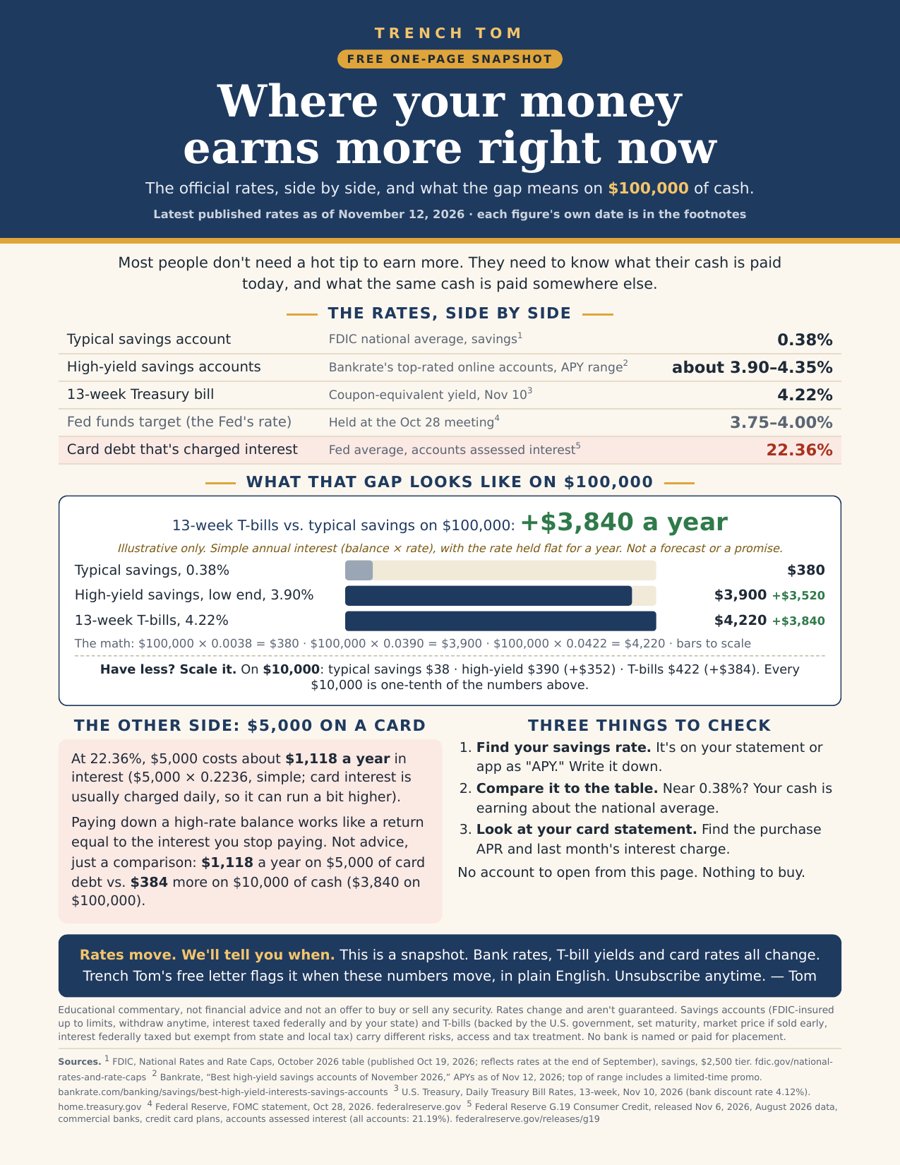
If you want major official rates on one dated page, get the free one-page Trench Tom rate snapshot. It shows each source and observation date. It requires an email, not a bank login, and it is an educational reference rather than a recommendation.
Which Treasury security has the shortest and longest term?
Among standard bills, notes and bonds, the 4-week bill has the shortest current term. The 30-year bond has the longest.
The distance between them changes how the security behaves:
- A 4-week bill has little time until maturity and no regular coupon payment.
- A 52-week bill keeps the same discount-security structure for about a year.
- A 2-year note begins the fixed semiannual-coupon range.
- A 10-year note is the longest standard note.
- A 20-year bond and 30-year bond extend fixed nominal payments far into the future.
Longer is not automatically better. Shorter is not automatically safer for every goal. A short maturity can create repeated reinvestment decisions. A long maturity can create larger market-price swings and a longer exposure to inflation.
Use the maturity date as a commitment date. If there is a meaningful chance the money will be needed earlier, include the early-sale process and potential price in the comparison before buying.
Frequently Asked Questions
1. Are Treasury bills, notes and bonds all backed by the U.S. government?
Yes. TreasuryDirect states that marketable Treasury securities are backed by the full faith and credit of the United States. That backing concerns scheduled government payments. It does not prevent market prices from rising or falling before maturity.
2. Do Treasury bills pay interest every six months?
No. Traditional Treasury bills generally produce interest through the difference between the purchase price and the face value paid at maturity. Notes and bonds pay fixed interest every six months.
3. What is the difference between a Treasury note and a Treasury bond?
The main difference is maturity. Notes currently mature in 2, 3, 5, 7 or 10 years. Bonds currently mature in 20 or 30 years. Both normally pay fixed interest every six months.
4. Can I lose money on a Treasury note or bond?
An early sale can produce a price below what you paid. A security bought above face value can also return less principal than its purchase price at maturity, although coupon payments are part of the total cash flow. Taxes, inflation and reinvestment also affect the result.
5. Is the coupon rate the same as the yield?
Not necessarily. The coupon rate determines the fixed interest payment on face value. Yield also reflects the price paid, time to maturity and scheduled cash flows. A note or bond can have a price above or below face value, causing yield to differ from the coupon rate.
6. Are Treasury bills, notes and bonds exempt from tax?
No. TreasuryDirect states that their interest is subject to federal income tax but exempt from state and local income taxes. Gains, losses, account types and personal circumstances can add other tax questions.
7. Can I sell a Treasury security directly inside TreasuryDirect?
No. TreasuryDirect says a marketable security must be transferred to a bank, broker or dealer for an early sale. Newly issued securities in TreasuryDirect are generally subject to a 45-day holding period before transfer or sale.
8. What is the minimum purchase for a Treasury bill, note or bond?
TreasuryDirect lists a $100 minimum purchase at auction, with purchases in $100 increments. The maximum noncompetitive bid is $10 million for a single auction, subject to current auction rules.
Source notes
- TreasuryDirect, “Treasury Bills,” accessed November 18, 2026. Supports current bill terms, discount structure, maturity payment, auction minimum and general tax treatment. Read the Treasury bill guide.
- TreasuryDirect, “Treasury Notes,” accessed November 18, 2026. Supports current note maturities, fixed rate, semiannual interest, minimum purchase and tax treatment. Read the Treasury note guide.
- TreasuryDirect, “Treasury Bonds,” accessed November 18, 2026. Supports current 20- and 30-year bond terms, fixed rate, semiannual interest, minimum purchase and the distinction from savings bonds. Read the Treasury bond guide.
- TreasuryDirect, “About Treasury Marketable Securities,” accessed November 18, 2026. Supports the meaning of marketable, federal backing and the distinction between marketable securities and savings bonds. Read the marketable-securities overview.
- TreasuryDirect, “Understanding Pricing and Interest Rates,” accessed November 18, 2026. Supports bill pricing mechanics, note and bond coupon payments, and the relationship among yield, coupon rate and price relative to par. Read the Treasury pricing guide.
- TreasuryDirect, “Selling a Treasury Marketable Security,” accessed November 18, 2026. Supports the bank, broker or dealer sale process and TreasuryDirect's 45-day original-issue holding restriction. Read the Treasury selling guide.
- TreasuryDirect, “Tax Forms and Tax Withholding,” accessed November 18, 2026. Supports the general rule that Treasury marketable-security earnings are subject to federal tax and exempt from state and local taxes. Read the Treasury tax guide.
Financial disclaimer: Trench Tom provides educational commentary only. Nothing in this article is a recommendation, offer, forecast, promise of return or individualized financial, investment, tax or legal advice. Verify current auction terms, prices, yields, tax rules and account procedures with official sources and relevant institutions.