A certificate of deposit and a high-yield savings account can show similar annual percentage yields. That does not mean they make the same promise.
An ordinary fixed-rate CD trades a term commitment for a specified rate. A savings account usually leaves the rate open to change while offering ongoing access under its account rules. The useful comparison starts with two questions: When might the money be needed, and which terms can change before then?
This guide compares ordinary bank deposits. It is not a ranking of today's offers. Every rate in the calculations is hypothetical, not a quote available on November 20, 2026.
Financial disclaimer: General educational commentary only, not financial, investment, tax or legal advice. Account terms, fees, insurance eligibility and access rules vary. No account is suitable for everyone, and no example promises earnings or savings.
Quick answer: How does a CD compare with a high-yield savings account?
A fixed-rate CD usually keeps its agreed rate for a stated term, but withdrawing early may trigger a penalty or may not be allowed. A high-yield savings account generally allows ongoing deposits and withdrawals under its rules, but its rate can change. Compare APY alongside access, minimum balances, fees, maturity and renewal terms. Eligible versions of both products can receive FDIC insurance at an insured bank, subject to coverage limits and ownership rules. A higher opening APY does not settle the comparison if the money must be withdrawn early or the rate later changes.
Key facts
- A CD has a maturity date. An ordinary savings account does not require a fixed holding term.
- Fixed-rate CDs and variable-rate savings accounts handle future rate changes differently.
- Not every CD is fixed-rate, freely redeemable early or protected from an issuer call.
- APY is an annualized deposit-yield measure, not the dollar earnings for every holding period.
- Early withdrawal penalties, minimums and fees belong beside the rate in any comparison.
- Automatic renewal can place a matured CD into another term under the renewal agreement.
- FDIC coverage is generally $250,000 per depositor, per insured bank, for each ownership category—not a separate limit for every CD and savings account.
- A rate illustration is not an offer, a forecast or a promise that one product will outperform another.
What are you agreeing to when you open each account?
A CD is a time deposit. You place money with a bank for an agreed term. The contract specifies the interest arrangement, maturity date and what happens if you want the money back sooner.
The FDIC's guide to shopping for a certificate of deposit explains that this term commitment distinguishes a CD from an ordinary savings account. The guide also warns that CDs can have complex features. The word CD does not establish every part of the contract.
For this comparison, a standard CD means a bank-issued, fixed-rate, noncallable deposit held directly with the bank. Noncallable means the bank does not have a contractual option to end it early through a call feature. If an actual offer differs, the comparison must change with it.
A high-yield savings account is still a savings deposit. The higher-yield description does not answer whether the rate is variable, whether a balance tier applies or whether an introductory period ends. Those answers come from the disclosure.
The FDIC's explanation of deposit disclosures identifies the important fields: APY, interest rate, minimum balances, opening information and fees. Read those fields together rather than treating the advertised percentage as the whole agreement.
Here is a compact way to organize the comparison:
| Question | Ordinary fixed-rate CD | High-yield savings account |
|---|---|---|
| Is there a maturity date? | Yes; the contract states it | Generally no fixed holding term |
| Can the rate change during the term? | Not under a plain fixed-rate contract | Usually yes, under variable-rate terms |
| What governs early access? | Redemption permission and penalty terms | Transfer, withdrawal, hold and fee rules |
| What happens later? | Maturity, withdrawal or possible renewal | Account continues under its current terms |
| What should be verified? | Rate structure, term, penalty, call and renewal provisions | Rate variability, tiers, minimums and access |
Neither column establishes an automatic winner. They describe different commitments.
Why can a savings rate change while a CD rate stays fixed?
The difference is contractual, not a special exemption from the rate environment.
For a plain fixed-rate CD, the bank has agreed to a rate for the term. The OCC explains that a bank does not have to increase a CD's rate just because market rates rose, unless the CD agreement requires that change.
That works in both directions for the ordinary noncallable fixed-rate product described here. New offers can become less attractive while the existing agreement continues. Or new offers can become more attractive while the existing agreement still pays its original rate.
A variable-rate savings account does not make that same term-long rate commitment. Its current APY describes current terms, not a guaranteed full-year outcome. Read how the bank can change the rate and whether promotional conditions apply.
For the broader background, how Fed rate changes affect savings accounts and Treasury bills explains why a policy decision is not the same thing as a bank setting an account rate.
Do not convert that relationship into a prediction. A fixed rate can be compared with today's savings rate. Tomorrow's savings rate remains unknown. Statements such as “the CD will definitely earn more” require assumptions about that unknown path, the holding period and costs.
There is also a distinction between a rate that is fixed and a rate that lasts indefinitely. The CD's commitment ends at maturity. A renewal is another contract period, not a permanent extension of the opening deal.
How do you compare the dollar interest without mixing up APY and rate?
Use the same starting balance and the same time window. Then state what must remain unchanged for the example to work.
Suppose two hypothetical accounts have these APYs:
- Savings account: 4.00% APY.
- One-year CD: 4.50% APY.
- Opening deposit in each example: $10,000.
Assume a full one-year holding period, all interest remains on deposit, the savings rate stays unchanged, and there are no fees, withdrawals or taxes in the calculation. Under those simplified APY assumptions:
Savings interest: $10,000 × 0.0400 = $400.
CD interest: $10,000 × 0.0450 = $450.
Illustrated difference: $450 − $400 = $50.
The $50 is a calculation, not a forecast. It does not prove that accepting a term commitment is worthwhile. It also does not show what would happen if the savings rate changed or the CD had to be redeemed early.
The distinction between APY and the underlying savings interest rate matters here. APY incorporates the account's compounding assumptions. The stated interest rate is a separate input used in accrual and, sometimes, penalty calculations.
Do not add another round of compounding to a full-year APY result. That would count the compounding effect twice. Do not assume a short CD pays its full advertised annual percentage over a few months either. Annualized percentages and holding-period dollars answer different questions.
For an actual offer, ask for the expected interest over the exact term, the interest-payment schedule and the maturity amount under the contract. Keep the estimate separate from penalties and taxes. If interest is paid out rather than retained, check how that changes the compounding assumptions.
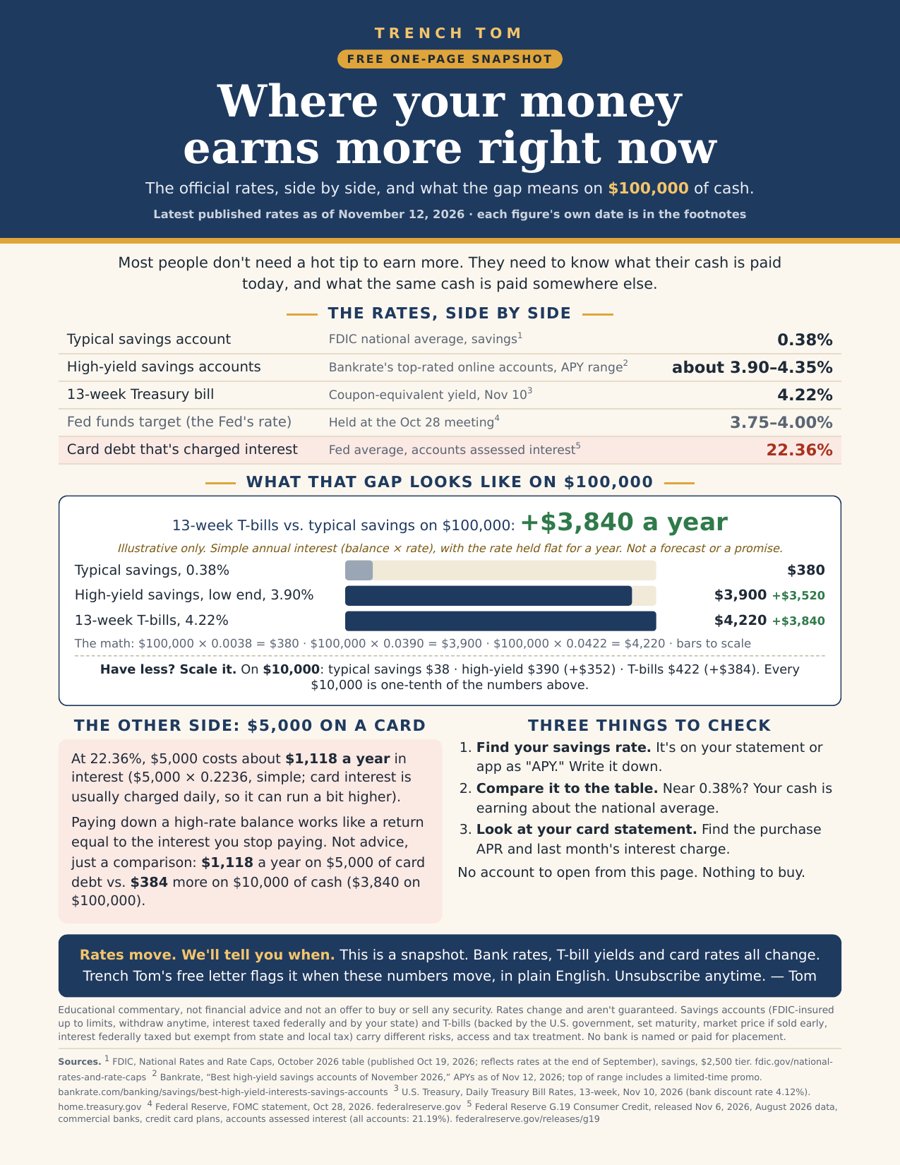
If you want official rate context on one dated page, the free one-page Trench Tom rate snapshot is a useful companion. It is an educational reference, not a product ranking or a claim that either account is right for you.
What can an early withdrawal penalty change?
It can change the dollars received and erase an apparent rate advantage.
The OCC's explanation of CD early withdrawal penalties emphasizes that CDs are not designed for unrestricted access. The agreement governs the bank's policies and charges. The FDIC also notes that some CDs do not allow early redemption.
Do not assume every penalty uses the same number of days, the same balance or the same interest-rate basis. Ask these questions before using a calculator:
- Is early withdrawal permitted at all?
- Is a partial withdrawal allowed, or must the account close?
- Which amount is the penalty applied to?
- Does the formula use the stated interest rate or another defined measure?
- How many days or months of interest are charged?
- Can the penalty exceed interest already earned and reduce principal?
- Are exceptions available, and what evidence is required?
Here is a separate hypothetical penalty example. It is not the 4.50% APY CD above.
Assume the agreement permits early redemption and charges 90 days of simple interest on a $10,000 withdrawal, using a 4.00% stated annual interest rate and a 365-day year:
Illustrative penalty = $10,000 × 0.04 × 90 ÷ 365 = about $98.63.
The calculation uses an interest rate, not APY. It assumes the stated balance is the penalty base. Actual contracts can calculate the charge differently. The OCC's penalty guidance directs depositors back to their account terms.
Before an early exit, request the redemption amount as of the intended date, with accrued interest and the penalty shown separately. A hypothetical formula is useful for learning. The bank's contract and dated payoff information are needed to reconcile an actual transaction.
Is the money equally accessible in both accounts?
No. Rate certainty and access are separate features.
A savings account usually does not require waiting for a maturity date. That does not mean every transfer is instant or unlimited. Ask about holds, transfer timing, withdrawal limits, fees and the destination account. A displayed available balance and money already received elsewhere are different operational states.
A CD can offer a permitted early-redemption path, but permission alone does not make that path costless. Some products may restrict access more sharply. The FDIC specifically warns that most market-linked CDs do not allow early redemption.
Start an access worksheet with a date, not an interest rate:
- What is the earliest date the cash might be needed?
- Is that date known or uncertain?
- Does the CD mature before that date?
- If the date changes, what exit terms apply?
- How long would withdrawal and transfer take?
- Which fees or penalties would affect the amount arriving?
These are comparison questions, not an instruction to put a particular sum in either account. There is no universal amount of accessible cash that this article can determine for a reader.
Do not import the sale rules of a security into a bank-deposit comparison. The guide to Treasury bills, notes and bonds explains how marketable securities have their own early-sale and price mechanics. A bank CD's permitted redemption is not the same process as selling a Treasury to another investor.
Does FDIC insurance give each account its own coverage limit?
No. Separate account labels do not automatically create separate insurance limits.
The FDIC's Deposit Insurance At A Glance guide, checked November 20, 2026, states the standard coverage amount as $250,000 per depositor, per insured bank, for each account ownership category. Eligible savings deposits and CDs are covered deposit types.
Deposits at the same bank in the same ownership category are generally combined for coverage purposes. A savings account and a CD do not each receive a fresh limit merely because they have different account numbers. The FDIC's CD-shopping guide also says to include accrued interest when reviewing coverage.
Verify the legal bank holding the deposit. A marketing brand or intermediary is not enough to establish the issuer's identity or the insurance result. If buying through a third party, the deposit placement and applicable coverage conditions require additional scrutiny.
Similar product names also deserve a check: the comparison of money market deposit accounts and money market funds explains why deposit insurance and investment protection are different.
Insurance addresses eligible deposits when an insured bank fails, within the rules. It does not turn a variable savings rate into a fixed rate. It does not waive a contractual early withdrawal penalty or make a market-linked product identical to a plain CD.
This article's coverage discussion concerns FDIC-insured banks. Credit-union accounts require a separate check of the institution's share-insurance status and applicable rules. When ownership arrangements or balances make the result unclear, use the relevant official estimator or contact the insurer rather than guessing from an account nickname.
What happens when the CD matures or renews automatically?
Maturity ends the stated term. What happens next depends on the agreement.
The CD might renew automatically, pay out under instructions or remain subject to other stated post-maturity terms. The OCC explains that there may be a grace period in which to decide whether to renew or withdraw. It also explains that automatic renewal can place the funds into a new CD.
Do not assume the new rate matches the old rate. Do not assume the new term matches the period you now need. Check both.
Record these fields before opening the account:
- Exact maturity date.
- Whether renewal is automatic.
- How to give withdrawal or renewal instructions.
- Any grace period and its deadline.
- The renewal term and how its rate is determined.
- Whether interest is paid after maturity or during the grace period.
The last point is not automatic. The OCC's post-maturity interest explanation says payment depends on the agreement and bank policy. A maturity date is therefore a review point, not a reason to stop reading notices.
This creates reinvestment uncertainty. A fixed-rate CD can establish its contractual rate during one term without establishing the rate available for the next term. Compare that uncertainty with the ongoing repricing of a variable savings account rather than pretending either product removes future decisions.
Which details can change the comparison before you choose?
The shortest useful answer is: verify the product, then the percentage.
A variable-rate CD, market-linked CD or callable CD is not the plain fixed-rate, noncallable CD used in this guide. The FDIC warns that a call feature can allow the issuer to end the deposit early under the contract. That can shorten the period for which a depositor expected to retain an attractive rate.
Likewise, a savings offer may have minimums, tiers, fees or promotional terms. A headline APY is only one field to copy into a comparison sheet.
Use this final checklist:
- Save the dated disclosure, not just the advertisement.
- Identify the legal bank and verify insurance status.
- Record APY and interest rate separately.
- Mark each rate fixed, variable, promotional or otherwise conditional.
- Compare the same balance and intended time window.
- Record minimums and fees.
- Write down the actual access and early-exit rules.
- Record CD maturity, renewal and call provisions.
- Check combined eligible deposits and accrued interest for coverage.
- Keep taxes outside a pretax comparison unless separately evaluated.
The goal is not to guess which rate will look best later. It is to understand what is fixed, what can change and what accessing the money could cost.
Frequently Asked Questions
1. Is a CD always better than a high-yield savings account?
No. A CD can provide contractual rate certainty for a term, while a savings account generally offers ongoing access with a variable rate. Penalties, fees, maturity and the timing of cash needs can matter as much as APY.
2. Can a bank change my fixed CD rate after opening?
For an ordinary fixed-rate CD, the agreement governs the rate during its term. Read for exceptions or different structures, including variable rates and call features. Renewal can establish a new rate.
3. Does a high-yield savings APY last for a full year?
Not necessarily. A variable-rate account can change its rate under its terms. The opening APY is an annualized comparison measure, not a promise of unchanged full-year interest.
4. Can I withdraw a CD before maturity?
Only under the applicable agreement. Some CDs permit early withdrawal with a penalty; others restrict redemption. Confirm permission, the penalty calculation and whether partial withdrawals are allowed.
5. Are CDs and savings accounts FDIC insured?
Eligible deposits at FDIC-insured banks can be insured within the coverage rules. The standard limit is $250,000 per depositor, per insured bank, per ownership category. Separate accounts do not automatically mean separate limits.
6. What happens if I forget about a maturing CD?
An automatically renewing CD may enter another term under the agreement. Review the maturity notice, any grace period, the renewal rate and withdrawal instructions. Do not assume the opening rate continues.
7. Does 4.50% APY mean a short CD pays 4.50% at maturity?
No. APY is annualized. A term shorter than a year generally produces a smaller holding-period percentage under ordinary positive-rate terms. Ask for the dollar interest and maturity amount for the exact contract period.
8. Are the example rates available today?
No offer is being quoted. The 4.00% and 4.50% APYs and the separate penalty illustration are hypothetical teaching inputs. Verify dated rates and complete terms directly with an institution.
Source notes
All sources below were retrieved November 20, 2026. These are official product-mechanics and coverage guides, not current rate surveys. Their original publication or review dates are retained rather than presented as new releases.
- FDIC, Shopping for a Certificate of Deposit, updated November 3, 2023. Supports term commitments, nonstandard rate structures, issuer checks, combined deposits, redemption limits, renewal and call features. Read the FDIC CD guide.
- FDIC, Deposit Insurance At A Glance, live guide checked November 20, 2026. Supports eligible deposit types, the $250,000 standard coverage framework and ownership-category aggregation. Read the insurance guide.
- FDIC, Start the New Year in the Know, January 2021 issue, updated July 25, 2023. Supports checking APY, interest rates, minimums and fees in deposit disclosures. Read the disclosure guide.
- OCC, CD interest-rate explanation, last reviewed April 2021. Supports the distinction between a contractual CD rate and changing market rates. Read the rate explanation.
- OCC, CD early withdrawal and penalty explanations, last reviewed April 2021. Support term commitments and account-specific penalty checks. Read the early-withdrawal explanation and penalty guidance.
- OCC, CD redemption and post-maturity interest explanations, last reviewed April 2021. Support conditional grace periods, automatic renewal and contract-dependent interest after maturity. Read the maturity explanation and post-maturity interest guide.
Financial disclaimer: Trench Tom provides educational commentary only. Nothing here recommends an account, predicts rates or guarantees earnings. Verify current disclosures, costs, insurance coverage and access rules. Personal financial, investment, tax and legal questions require appropriate individual review.