A savings account can show an interest rate and an annual percentage yield, or APY. The two numbers may be equal. They may also be slightly different.
That difference is not a fee. It comes from compounding.
The interest rate is the basic annual rate used to calculate interest. APY estimates the total interest earned over a year when interest is added to the balance and can earn more interest. APY is usually the cleaner starting point for comparing deposit accounts, but it does not replace the account terms.
Financial disclaimer: This article is general educational commentary, not financial, investment, tax or legal advice. Rates, fees, balance requirements, insurance coverage and withdrawal rules vary. Verify the current disclosure and institution before making a financial decision.
Quick answer: What is the difference between APY and interest rate on a savings account?
The interest rate is the annual rate the institution applies to the account balance. The annual percentage yield, or APY, reflects that interest rate plus the effect of compounding over a 365-day period.
If an account pays 4.00% interest and compounds daily, its APY is about 4.08%, assuming the rate and balance stay unchanged and the interest remains in the account. If the account compounds only once per year, a 4.00% interest rate produces a 4.00% APY. Use APY to compare deposit yields, then check whether the rate is variable, promotional, tiered or subject to minimum-balance and fee rules.
Key facts
- Interest rate and APY are related, but they are not always the same number.
- APY includes the effect of compounding. The stated interest rate does not.
- More frequent compounding can produce a higher APY when the underlying interest rate is the same.
- A 4.00% interest rate compounded daily produces an APY of about 4.08%.
- APY assumes principal and interest remain on deposit for the stated period under the disclosure rules.
- Savings-account rates are often variable, so the actual dollars earned can differ from the opening APY illustration.
- Fees, balance tiers and minimums can matter even when one advertised APY looks higher.
- Federal rules require applicable account disclosures to identify both the annual percentage yield and interest rate.
- Deposit insurance depends on the institution, ownership category and total eligible deposits, not on the advertised APY.
What does the interest rate on a savings account mean?
The interest rate is the basic annual percentage used in the account's interest calculation. It is sometimes called the nominal rate because it does not, by itself, show the additional effect of earning interest on previously credited interest.
Suppose a savings account has a 4.00% interest rate. A simple one-year calculation on a constant $10,000 balance would be:
$10,000 × 0.04 = $400
That $400 result matches an account that compounds once at the end of the year. If the institution compounds more often, some interest is added before year-end. The new interest can then earn interest too. That pushes the one-year yield above 4.00%.
Federal Regulation DD governs deposit-account disclosures. Its current account-disclosure rule says institutions must disclose the annual percentage yield and the interest rate, using those terms. For a variable-rate account, the disclosure also describes that the rate may change, how it is determined, how often it may change and any limits on changes.
The interest rate is still important. Regulation DD generally requires institutions to calculate interest on the full amount of principal for each day using the daily balance method or average daily balance method. It also requires a daily rate of at least 1/365 of the interest rate, with specific leap-year treatment allowed.
The account agreement controls the exact mechanics. A statement may show interest accrued daily but credited monthly. Accrual is the earning process. Crediting is when the institution posts that interest to the account.
What does APY mean on a savings account?
APY means annual percentage yield. It turns the rate and compounding schedule into one annualized percentage.
The Consumer Financial Protection Bureau's current Regulation DD definition says APY reflects the total amount of interest paid on an account based on the interest rate and compounding frequency for a 365-day period. Appendix A provides the calculation rules.
For a typical savings account without a stated maturity date, the APY calculation assumes a 365-day term. It also assumes that the principal and interest stay in the account for the full term and that no other deposits or withdrawals occur.
Those assumptions make APY useful for side-by-side comparisons. They do not promise that a real balance or rate will remain steady.
For example, if two savings accounts both advertise a 4.08% APY, the APY gives a standardized estimate of their annual interest yield under the required assumptions. One account may compound daily and another may use a different interest rate and schedule that produces the same disclosed APY.
The accounts can still differ in important ways:
- one rate may be promotional;
- one may require a larger balance;
- one may charge a monthly fee;
- one may pay the top APY only on part of the balance;
- one may require direct deposit or a transaction target;
- transfer speed and withdrawal procedures may differ;
- the institutions may have different insurance status or ownership rules.
APY makes the yield easier to compare. It does not make the products identical. The comparison of CDs and high-yield savings accounts shows why rate certainty, early withdrawal penalties and maturity terms belong beside APY.
How does compounding create a gap between interest rate and APY?
Compounding means interest can earn interest.
A common formula for an account with a fixed nominal rate and regular compounding is:
APY = (1 + interest rate ÷ compounding periods per year)^(compounding periods per year) − 1
Use decimals in the formula. A 4.00% rate becomes 0.04.
Here is what happens to a constant $10,000 balance at a 4.00% interest rate under several simplified compounding schedules. The examples assume the rate does not change, all interest stays in the account, there are no deposits or withdrawals, and there are no fees.
| Compounding schedule | Calculated APY | Approximate interest after one year |
|---|---|---|
| Annual | 4.0000% | $400.00 |
| Quarterly | 4.0604% | $406.04 |
| Monthly | 4.0742% | $407.42 |
| Daily, using 365 periods | 4.0808% | $408.08 |
For daily compounding, the calculation is:
(1 + 0.04 ÷ 365)^365 − 1 = about 0.0408085
That equals an APY of about 4.08%.
The extra $8.08 in this illustration is not a bonus added by the institution. It is the result of interest being added during the year and then becoming part of the interest-bearing balance.
The gap gets wider as the rate rises or compounding becomes more frequent. Still, the difference between monthly and daily compounding may be smaller than the effect of a fee, changing rate or balance requirement.
This is why APY is the better yield comparison than the nominal interest rate alone. It already absorbs the scheduled compounding effect into one annual figure.
Can two accounts with the same APY earn different dollar amounts?
Yes. The same APY does not guarantee the same dollars in a real account.
APY is an annualized comparison measure. Actual interest depends on the balance present each day and the rate in effect during those days.
Consider two people who open the same account with the same advertised APY:
- One deposits $10,000 and leaves it untouched for a year.
- The other starts with $10,000, withdraws $4,000 after one month and makes several later deposits.
Their dollar interest will differ because their daily balances differ.
Most savings accounts have variable rates. If an account opens at 4.08% APY and the institution later lowers the rate, full-year earnings will not equal the opening APY multiplied by the starting balance. The opening APY was not a one-year lock.
The broader rate environment can influence those changes, but the Federal Reserve does not set a bank's APY. The explanation of how Fed rate changes affect savings accounts and Treasury bills follows that transmission chain.
Fees create another gap. If an account earns $30 of interest but charges a $10 maintenance fee, the net balance improvement from those items is $20. APY does not turn every account cost into one net-return number.
Transaction timing matters too. Regulation DD allows daily balance and average daily balance methods. A deposit present for more days generally has more opportunity to earn interest. A withdrawal reduces the amount that can accrue interest after it leaves the account.
Use APY to normalize the advertised yield. Use the account ledger to understand the actual dollars.
Why might actual savings interest differ from the advertised APY?
A real account rarely follows the disclosure assumptions perfectly for a full year.
Common reasons include:
- The rate changed. Variable savings rates can rise or fall after the account opens.
- The balance changed. Deposits and withdrawals alter the amount earning interest.
- A minimum was missed. Some accounts require a daily or average balance to earn interest or avoid a fee.
- The top APY applied only to a tier. A headline rate may cover a specific balance range rather than every dollar.
- A promotion ended. An opening rate may last for a stated period and then reset.
- A condition was not met. Some accounts require direct deposit, debit transactions or another activity to earn the highest rate.
- Fees reduced the balance. APY is an interest-yield measure, not a guarantee of net account growth after fees.
- Interest was withdrawn. Removing credited interest prevents that amount from compounding in the account.
- The comparison covered less than a year. A short statement period can be annualized, but the dollar interest reflects only that period.
- The quoted APY was stale. The rate shown on a comparison page may no longer match the institution's current disclosure.
The statement may also show annual percentage yield earned, which differs from the opening advertised APY. Regulation DD annualizes the relationship between interest earned during the statement period and the average daily balance.
That number can help reconcile a completed statement. The advertised APY uses standardized assumptions. APY earned describes the completed statement period on an annualized basis.
If the amount looks wrong, start with four items: the daily balances, the interest rate in effect, the number of days and the compounding or crediting terms. Then check minimums, tiers and fees.
How do variable, tiered and promotional savings rates work?
A variable rate can change at the institution's discretion or according to an identified index and margin, depending on the account terms. The disclosure should explain how the rate is determined and how often it may change.
A tiered account applies different rates to specified balance levels. There are two broad structures.
Under one method, the rate for the reached tier applies to the full balance. Under another, each rate applies only to the part of the balance inside that tier. Those structures can produce different interest even when the same rates and tier cutoffs appear in an advertisement.
A promotional account may pay a higher rate for a limited period or only after certain conditions are met. The useful questions are:
- When does the promotion begin and end?
- What rate or APY applies afterward?
- Is the rate available to existing customers?
- Does it apply to the full balance?
- Is there a minimum or maximum qualifying balance?
- Must another account, direct deposit or transaction target be maintained?
- Can the institution change the non-promotional rate at any time?
Do not blend a temporary APY and a permanent APY into one guess unless the disclosure gives the required composite calculation. Record the dates and conditions instead.
The same discipline applies when reading other annualized financial percentages. Credit card APR becomes a periodic rate applied to a borrowing balance, while a savings APY describes deposit interest and compounding. One is a borrowing-cost measure. The other is a deposit-yield measure.
What should you compare besides APY before opening a savings account?
Start with the APY, then audit the terms around it.
Use this checklist:
- Rate date. Confirm when the quoted interest rate and APY were accurate.
- Variable or fixed. Most ordinary savings rates can change. A fixed-rate certificate has a different term and access structure.
- Compounding and crediting. Check how often interest compounds and when it is posted.
- Minimum to open. This may differ from the minimum needed to earn the advertised APY.
- Balance tiers. Identify which dollars receive each rate.
- Monthly fees. Check the amount and waiver conditions.
- Activity requirements. Confirm any direct-deposit, card-use or transaction rules.
- Withdrawal and transfer process. Review timing, holds, limits and any institution-specific fees.
- Promotion end date. Record the rate that applies afterward if it is disclosed.
- Institution identity. Confirm the legal bank or credit union holding the deposit, especially when an app or financial-technology company is the customer-facing brand.
- Deposit insurance. Verify FDIC or NCUA coverage and how your ownership category and other deposits at the same institution affect the limit.
- Customer-service access. Know how to resolve a transfer, beneficiary or account-access problem.
The FDIC states that eligible deposits are automatically insured when held at an FDIC-insured bank, subject to coverage rules. The standard amount is $250,000 per depositor, per insured bank, for each account ownership category. NCUA provides comparable federal share insurance for eligible deposits at federally insured credit unions, with coverage depending on account ownership and applicable rules.
The insurance limit is not “per account” in every situation. Several accounts in the same ownership category at one institution may be added together. Use the official FDIC or NCUA tools when balances or ownership structures make coverage less obvious.
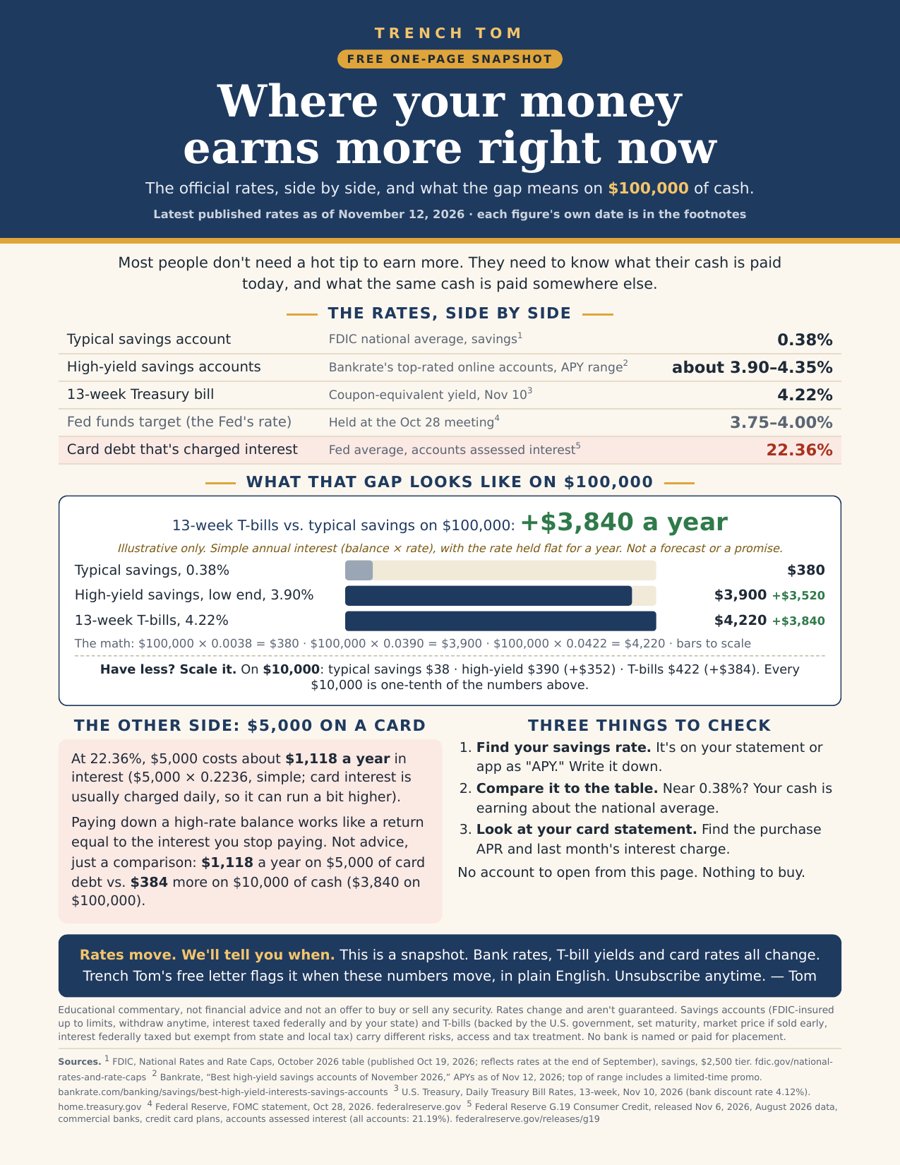
If you want the main official cash rates gathered on one dated page, get the free one-page Trench Tom rate snapshot. It shows the source and date beside each number. It requires only an email and no bank login. It is an educational reference, not a statement that an account is suitable for you.
How does savings APY compare with Treasury yields and credit card APR?
The labels all annualize a percentage. They measure different cash flows.
| Rate label | What it describes | Important limitation |
|---|---|---|
| Savings APY | Deposit interest including the stated compounding effect | The rate may be variable, and fees or conditions still matter |
| Savings interest rate | Basic annual rate used to accrue deposit interest | Does not show the full compounding effect by itself |
| Treasury bill investment or coupon-equivalent rate | Annualized return on a discount security relative to its price | Not a bank APY and may require reinvestment after maturity |
| Credit card APR | Annualized cost rate applied to borrowing balances | Does not include every fee and may be applied daily |
A Treasury bill is a marketable U.S. government security. A savings account is a deposit at a bank or credit union. Their access, price behavior, tax treatment and protection structures differ.
The guide to Treasury bill discount rates versus investment rates explains why one bill can display multiple valid yields. A bill's coupon-equivalent rate may be a better starting point than its bank discount rate for some comparisons, but it still is not an APY.
A savings APY assumes interest remains on deposit under the calculation rules. A short Treasury bill matures. Continuing for a full year would require buying another security at a future rate that is not known today. A credit card APR goes the other direction: it measures a cost on borrowed money rather than yield on saved money.
A fund's seven-day yield adds another label to check. The guide to money market accounts versus money market funds explains that yield comparison alongside the deposit-versus-investment distinction.
Match the percentage label to the product before comparing the number.
Frequently Asked Questions
1. Is APY always higher than the interest rate?
APY is higher when interest compounds more than once per year and the stated rate is positive. APY can equal the interest rate when interest compounds only annually or when rounding makes the displayed figures the same.
2. What APY does a 4.00% savings interest rate produce?
At daily compounding with 365 periods, a 4.00% interest rate produces an APY of about 4.08%. Monthly compounding produces about 4.07%. The exact disclosure depends on the institution's terms and required calculation rules.
3. Does a 4.00% APY mean I earn $400 on $10,000?
It means a constant $10,000 balance would earn about $400 over a year under the APY assumptions. A changing rate, deposits, withdrawals, fees, tiers or removed interest can change the actual result.
4. Can a bank change a savings account APY after I open it?
Usually yes for a variable-rate savings account. The account disclosure should state that the rate and APY may change and explain how the rate is determined. Fixed-term deposit products can have different rules.
5. How often should savings interest compound?
Institutions may use different compounding and crediting schedules. More frequent compounding creates a slightly higher APY when the nominal rate is the same. Compare the disclosed APY and the full account terms rather than choosing a schedule in isolation.
6. What is annual percentage yield earned on a statement?
It is an annualized measure based on the interest actually earned and the relevant average daily balance during the statement period. It can differ from the advertised APY because balances or rates changed.
7. Is a Treasury bill yield the same as a savings APY?
No. Treasury bill yields use security-market conventions and a bill has a maturity date. Savings APY uses deposit-account compounding assumptions. Liquidity, taxes, insurance or backing and reinvestment also differ.
8. Does FDIC or NCUA insurance protect the advertised interest rate?
No. Deposit or share insurance protects eligible deposits if an insured institution fails, subject to limits and ownership rules. It does not lock a variable rate or guarantee that an advertised APY will remain available.
Source notes
- Consumer Financial Protection Bureau, Regulation DD, 12 CFR § 1030.2, current version accessed November 16, 2026. Supports the federal definition of annual percentage yield as a rate reflecting interest and compounding over a 365-day period. Read the Regulation DD definitions.
- Consumer Financial Protection Bureau, Regulation DD, 12 CFR § 1030.4, current version accessed November 16, 2026. Supports required disclosure of APY and interest rate and the rules for variable, tiered and stepped rates. Read the account-disclosure rule.
- Consumer Financial Protection Bureau, Regulation DD, 12 CFR § 1030.7, current version accessed November 16, 2026. Supports daily and average daily balance methods, daily-rate requirements, compounding and crediting policies, and interest-accrual rules. Read the payment-of-interest rule.
- Consumer Financial Protection Bureau, Regulation DD Appendix A, current version accessed November 16, 2026. Supports the APY formula, 365-day assumption, compounding treatment, tiered-account methods and annual percentage yield earned. Read the APY calculation appendix.
- Federal Deposit Insurance Corporation, “Deposit Insurance At A Glance,” accessed November 16, 2026. Supports automatic coverage for eligible deposits at FDIC-insured banks and the standard $250,000 amount per depositor, per insured bank, for each ownership category. Read the FDIC deposit-insurance guide.
- National Credit Union Administration, “Frequently Asked Questions About Share Insurance,” accessed November 16, 2026. Supports federal share-insurance coverage for eligible deposits at federally insured credit unions and the general $250,000 coverage framework. Read the NCUA share-insurance FAQ.
Financial disclaimer: Trench Tom provides educational commentary only. Nothing in this article is a recommendation, offer, forecast, promise of return or individualized financial, investment, tax or legal advice. Verify current rates, disclosures, fees, insurance status and account terms with official sources and the institution.