A Treasury bill can show more than one rate for the same security. That is not a typo.
The U.S. Treasury's daily table lists a bank discount rate and a coupon equivalent rate for each bill maturity. Auction results may also show a high rate and an investment rate. The numbers differ because the formulas use different denominators and different day-count conventions.
That difference matters when you compare a bill with another bill, a savings account, a certificate of deposit or a Treasury note. The biggest percentage on the screen is not automatically the best comparison.
Financial disclaimer: This article is general educational commentary, not financial, investment, tax or legal advice. Treasury prices, yields, taxes, account rules and transaction costs can vary. Verify the current security, dates, quote type and platform terms before making a financial decision.
Quick answer: What is the difference between a Treasury bill discount rate and investment rate?
A Treasury bill's bank discount rate measures the discount from face value as a percentage of face value, annualized with a 360-day year. The investment rate, also called the coupon equivalent or bond equivalent rate in Treasury data, measures the return relative to the lower purchase price and uses a 365- or 366-day year.
Because the investment-rate formula uses the money actually paid rather than the larger face value, it is normally higher than the bank discount rate for a bill sold below face value. On November 13, 2026, Treasury listed the 13-week bill at a 4.13% bank discount rate and a 4.23% coupon equivalent rate.
Key facts
- Treasury bills mature in one year or less and are generally sold at a discount or at face value.
- A bill normally pays its face value at maturity rather than making periodic coupon payments.
- The bank discount rate divides the dollar discount by face value and annualizes it on a 360-day basis.
- The investment rate uses the purchase price and a 365- or 366-day year.
- One bill can correctly have a 4.13% bank discount rate and a 4.23% investment-style rate.
- Treasury's daily bill rates are secondary-market quotations on the most recently auctioned bills, collected at about 3:30 p.m. Eastern on business days.
- An auction rate, a secondary-market quote, a bank APY and a note's yield to maturity are not interchangeable labels.
- A noncompetitive bidder accepts the rate set at the auction and does not know that rate when placing the order.
- Selling a bill before maturity can produce a different result from holding it until face value is paid.
Why does one Treasury bill have two different rates?
A Treasury bill is a discount security. Suppose a bill will pay $1,000 at maturity. If its purchase price is $989.56, the difference of $10.44 is the interest earned when it is held to maturity, before taxes and transaction effects.
There are at least two ways to turn that $10.44 into an annualized percentage.
The first method compares the discount with the $1,000 face value. It also uses a 360-day year. Treasury calls this the bank discount rate.
The second method compares the interest with the $989.56 purchase price, because that is the cash actually invested. It uses 365 days in an ordinary year or 366 days in a leap year. Treasury calls this the investment rate in auction materials. Its daily rate table labels the comparable measure the coupon equivalent rate.
The second denominator is smaller. Its annualization period is also slightly longer. Those two choices normally make the investment-style rate higher.
Neither number changes the bill's cash flows. The buyer still pays the purchase price and receives face value at maturity if the bill is held. The labels are two measuring tapes placed against the same transaction.
This is why a rate must be read with its formula. A percentage without its measure can create a false comparison.
How is the Treasury bill bank discount rate calculated?
TreasuryDirect gives this pricing formula for a bill:
Price = Face value × (1 − (discount rate × time) ÷ 360)
The formula can also be rearranged to solve for the bank discount rate:
Bank discount rate = (Face value − Price) ÷ Face value × 360 ÷ Days to maturity
Notice the two defining choices:
- The dollar discount is divided by face value, not purchase price.
- The result is annualized using 360 days.
Here is an illustration using a $1,000 face value, 91 days and a 4.13% bank discount rate. This is a formula example, not the exact price of a specific November 13 security.
Price = $1,000 × (1 − (0.0413 × 91) ÷ 360)
Price = about $989.56
The maturity payment would be $1,000. The difference would be about $10.44.
| Illustration item | Amount or formula |
|---|---|
| Face value paid at maturity | $1,000.00 |
| Assumed bank discount rate | 4.13% |
| Assumed term | 91 days |
| Estimated purchase price | $989.56 |
| Difference received at maturity | $10.44 |
The 4.13% rate does not mean the buyer earns 4.13% of the $989.56 purchase price during 91 days. It is an annualized quotation convention based on face value.
That convention has a long market history and remains useful for quoting bills consistently. It is less useful when someone assumes it works like a deposit APY.
How is the Treasury bill investment rate calculated?
The investment rate starts with the same dollar result but measures it against the purchase price.
A simplified annualized formula for the illustration is:
Investment rate = (Face value − Price) ÷ Price × 365 ÷ Days to maturity
Using the same assumed bill:
Investment rate = $10.44 ÷ $989.56 × 365 ÷ 91
Investment rate = about 4.23%
That is about one-tenth of a percentage point above the 4.13% bank discount rate. The gap is not extra money. It comes from a different calculation.
The exact Treasury calculation can depend on the security's actual days to maturity and the applicable year length. Rounding can also move the displayed result by a small amount.
Treasury's November 13, 2026 daily table provides a real-world check on the relationship:
| Bill maturity | Bank discount rate | Coupon equivalent rate |
|---|---|---|
| 4 weeks | 3.95% | 4.02% |
| 6 weeks | 4.01% | 4.08% |
| 8 weeks | 4.08% | 4.16% |
| 13 weeks | 4.13% | 4.23% |
| 17 weeks | 4.22% | 4.34% |
| 26 weeks | 4.31% | 4.47% |
| 52 weeks | 4.42% | 4.63% |
These were secondary-market quotations, not guaranteed rates for a future auction or a quote from a particular broker. Treasury says the table reflects the most recently auctioned bills in each maturity tranche, with market quotations obtained at about 3:30 p.m. each business day.
The pattern is consistent. In every row, the coupon equivalent rate is above the bank discount rate.
Is the coupon equivalent rate the same as the investment rate?
For practical reading of Treasury bill data, the terms point to the investment-style yield rather than the bank discount quotation. Treasury's daily rates page says the coupon equivalent is also called the bond equivalent or investment yield.
The purpose is comparison. A Treasury note or bond pays coupon interest, while a bill generally earns its return through the difference between purchase price and face value. Converting the bill to a bond-equivalent measure makes the annualized figures easier to place side by side.
That yield conversion does not erase the product differences. The guide to Treasury bills versus notes and bonds compares their maturities, payment schedules and early-sale price risk.
But “easier” does not mean “identical.” A bill still does not become a coupon-paying note. Its cash-flow timing remains different. A bill's interest is generally realized at maturity. A note normally pays interest every six months.
The comparison also does not turn the coupon equivalent rate into a bank APY. The explanation of APY versus a savings account interest rate shows how the deposit measure includes a compounding convention over a year. A short bill may mature and need to be reinvested. The rate available at that future date is unknown.
This is the same reason readers should be careful when they compare savings APYs with Treasury bill yields. The products, formulas, access rules and reset risks differ even when the percentages look close.
Which Treasury bill rate should you use for comparisons?
Use the measure that matches the question.
If the question is, “How is this bill quoted in the discount market?” the bank discount rate is relevant.
If the question is, “What annualized return does the discount represent relative to the purchase price?” the investment rate is more informative.
If the question is, “How does this compare with a note or another yield quote?” the coupon equivalent rate is usually the closer starting point.
If the question is, “How does this compare with a savings account or CD?” neither number completes the job. Compare all of these items:
- Rate measure. Confirm whether the number is a bank discount rate, investment rate, coupon equivalent rate, APY or yield to maturity.
- Quote date. A rate from last week may not describe today's market.
- Purchase channel. An auction purchase, TreasuryDirect holding and broker purchase can involve different timing and procedures.
- Maturity. A 4-week bill and a 52-week bill lock cash for very different periods.
- Reinvestment. A short bill may mature several times during a year. Future rates are unknown.
- Access. A bank deposit may permit withdrawals. A bill must mature or be sold.
- Price risk. A bill sold before maturity can be worth more or less than the purchase price.
- Taxes. TreasuryDirect states that bill interest is subject to federal tax but not state or local tax. Personal circumstances can affect the final result.
- Insurance and backing. Eligible bank deposits and Treasury securities have different legal structures and protections.
- Fees and spreads. A platform or transaction may create costs not visible in the Treasury's published rate.
The rate label is the first checkpoint, not the final decision.
Are daily Treasury bill rates the same as auction rates?
No. They describe different moments and can come from different parts of the market.
An auction establishes the terms for a new Treasury issue. Treasury first accepts valid noncompetitive bids. It then accepts competitive bids from the lowest rate upward until the offered amount has been awarded. All successful bidders receive the same highest accepted rate, yield or discount margin.
TreasuryDirect customers place noncompetitive bids. They agree to accept the auction result. TreasuryDirect says the rate is not known when the purchase is scheduled.
The daily Treasury bill table is different. It reports secondary-market quotations for the most recently auctioned bill in each maturity group. Those quotes can change after the auction because market prices change.
That creates three dates worth checking:
- Auction date: when bids are accepted and the result is set.
- Issue date: when payment is taken and the security is delivered.
- Quote date: when a secondary-market rate is observed.
For 13-week and 26-week bills, Treasury's normal schedule calls for an announcement on Thursday, an auction the following Monday and issue on the following Thursday, except when holidays or special circumstances change the pattern.
A rate shown on Friday afternoon is therefore not a promise about the next Monday auction. It is a dated market observation.
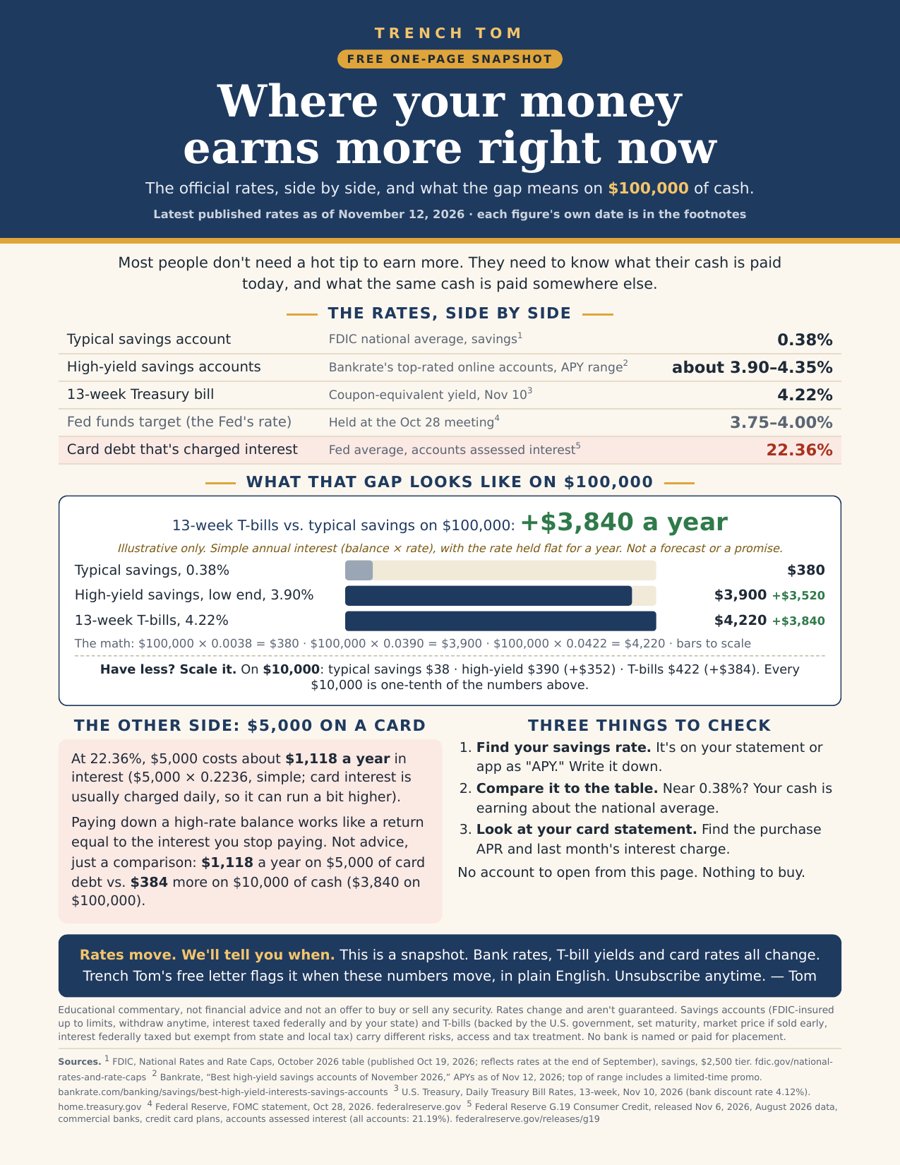
If you want the main official rates gathered on one dated page, get the free one-page Trench Tom rate snapshot. It shows the source and date beside each figure. It is an educational reference, not a recommendation to buy a security or open an account.
What happens if you sell a Treasury bill before maturity?
Holding a bill to maturity produces a simple contractual cash flow: Treasury pays the face value, subject to U.S. government payment. Selling early introduces a market price.
If market yields rise after the purchase, an existing bill's price will generally fall because a buyer can seek a newer bill with a higher yield. If market yields fall, the existing bill's price may rise.
The effect is usually smaller for a bill close to maturity than for a long-term bond, but it is not automatically zero. A broker's bid, spread, fee and settlement process can also affect the amount received.
TreasuryDirect adds an operational limit. Newly bought marketable securities generally must remain in a TreasuryDirect account for at least 45 calendar days before they can be transferred or sold. TreasuryDirect itself does not provide a direct sell button; a security that is eligible for sale must be moved to a bank, broker or dealer.
That means the maturity plan matters before the purchase. A bill intended for a known expense should have a maturity date that fits the cash need, with room for settlement and transfer timing.
The displayed investment rate assumes the bill is held through the stated period under the formula. An early sale replaces the maturity payment with an unknown market price.
How are Treasury bill yields different from credit card APR and savings APY?
All three are annualized percentages. They describe different cash flows.
A Treasury bill yield measures the return on a security bought at a discount and paid at face value at maturity. The bank discount and investment-rate conventions use different denominators.
A savings APY describes a deposit account's annual yield under a compounding assumption. The institution can usually change a variable savings rate after the account is opened.
A credit card APR describes the annualized cost of borrowing. Issuers commonly convert it to a periodic rate and apply it to balances under the card agreement. The daily-balance mechanics are explained in the guide to how credit card interest is calculated.
| Percentage label | What it measures | Common base |
|---|---|---|
| Bill bank discount rate | Annualized discount from face value | Face value and 360-day year |
| Bill investment rate | Annualized return relative to price paid | Purchase price and 365/366-day year |
| Savings APY | Annual yield including stated compounding | Deposit balance under account terms |
| Credit card APR | Annualized borrowing rate | Balance defined by card agreement |
A 4.23% bill investment rate and a 4.23% savings APY do not guarantee the same dollars over the same real-world period. A 22% credit card APR is not a mirror image of either one. Taxes, timing, compounding, changing balances, liquidity and product rules all differ.
Match the percentage to the cash flow before comparing the number.
Frequently Asked Questions
1. Why is a Treasury bill's investment rate higher than its discount rate?
The investment rate divides the bill's interest by the lower purchase price and annualizes with 365 or 366 days. The bank discount rate divides by the larger face value and uses 360 days. The different formulas normally make the investment rate higher.
2. What was the 13-week Treasury bill rate on November 13, 2026?
Treasury's daily secondary-market table listed a 4.13% bank discount rate and a 4.23% coupon equivalent rate for the 13-week maturity tranche.
3. Does a 4.13% discount rate mean I earn 4.13% in 13 weeks?
No. It is an annualized quotation based on face value and a 360-day year. The actual dollar return depends on the purchase price, face value and days to maturity.
4. Is Treasury bill interest paid every month?
No. A traditional Treasury bill generally pays no periodic coupon. The interest is the difference between the discounted purchase price and the face value paid at maturity.
5. Is the coupon equivalent rate the same as APY?
No. The coupon equivalent rate is a bond-style annualized yield measure for a discount bill. APY uses a deposit-account compounding convention. Reinvestment, access and product terms also differ.
6. Do I know a Treasury bill's auction rate before buying in TreasuryDirect?
No. A TreasuryDirect buyer submits a noncompetitive bid and agrees to accept the rate determined at auction. The result is available after the auction.
7. Can I sell a Treasury bill before maturity?
Yes, through a bank, broker or dealer, subject to platform and transfer rules. The sale price can be above or below the purchase price. TreasuryDirect generally requires a 45-day holding period before a newly bought marketable security can be transferred or sold.
8. Is Treasury bill interest exempt from all taxes?
No. TreasuryDirect states that bill interest is subject to federal income tax but not state or local income tax. Account type and individual circumstances can matter, so this general rule is not personal tax advice.
Source notes
- U.S. Department of the Treasury, “Daily Treasury Bill Rates,” November 13, 2026. Supports the current bill-rate table, the secondary-market nature and timing of the quotations, and Treasury's definitions of bank discount and coupon equivalent rates. Read the Treasury rate table.
- TreasuryDirect, “Treasury Bills,” accessed November 14, 2026. Supports bill terms, available maturities, minimum purchase, auction frequency, maturity payment and general federal versus state and local tax treatment. Read the TreasuryDirect bill guide.
- TreasuryDirect, “Understanding Pricing and Interest Rates,” accessed November 14, 2026. Supports the bill pricing formula and the explanation that bill interest is the difference between purchase price and face value. Read the TreasuryDirect pricing guide.
- TreasuryDirect, “How Auctions Work,” accessed November 14, 2026. Supports the auction sequence, uniform-rate result, and competitive versus noncompetitive bidding mechanics. Read how Treasury auctions work.
- TreasuryDirect, “Buying a Treasury Marketable Security,” accessed November 14, 2026. Supports the statement that TreasuryDirect purchases use noncompetitive bids, the rate is not known when scheduled, the $100 minimum and increment, and the 45-day transfer or sale restriction. Read the TreasuryDirect buying guide.
- TreasuryDirect, “General Auction Timing,” accessed November 14, 2026. Supports the normal announcement, auction and issue pattern for 13-week and 26-week bills. Read Treasury's general auction timing.
Financial disclaimer: Trench Tom provides educational commentary only. Nothing in this article is a recommendation, offer, promise of return or individualized financial, investment, tax or legal advice. Verify current rates, prices, dates and terms with official sources and relevant institutions.